Yep.
Click PLAY or watch it on Twitter.
tumbling, tramp, diving, acrobatics, circus, cheer, dance, martial arts, X sports … and more
I’d argue Kohei Uchimura singled handedly reinvented how male gymnasts land.
Easily the best in the world in his prime, many emulated Kohei’s exaggerated technique.
I love it as he turned the science of safely reducing huge impact forces to zero into an art form.
At the same time WAG was foolishly deducting low chest position. Dangerous!
Of his many stuck routines over many years, Blythe chose this as one of her decade-defining routines.
Click PLAY or watch it on YouTube.
I’ve not used either of these, but they look promising. Leave a comment if you’ve tried any alternatives to standard casts.
Click PLAY or watch FlexiOH™ on YouTube.
FlexiOH™ details.
Click PLAY or watch Cast21 on YouTube.
Cast21 details.
Does anyone have statistics on this?
I feel certain we are seeing more severe injuries on Vault landings, on average, than on any other apparatus.
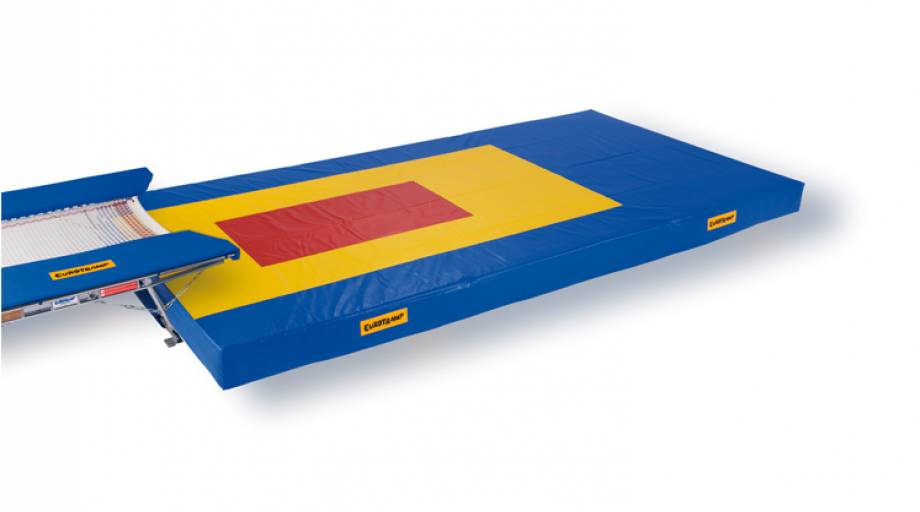
I’d recommend FIG require a mat more like the safer one used by Trampoline sports on double-mini.
Leave a comment if you have an opinion.
Abstract
Achilles injury risk in women’s collegiate gymnastics is 10-fold higher than in all other collegiate sports. This study aims to identify risk factors for Achilles tendon ruptures in collegiate female gymnasts.Hypothesis:
Factors Associated With Achilles Tendon Rupture in Women’s Collegiate Gymnastics
Gymnasts with Achilles tendon ruptures will be more likely to report early gymnastics specialization, elite-level training before college, and performance of high-difficulty skills on floor and vault. …

The “twisties” phenomenon is real.
I’ve experienced it myself and have had several national team gymnasts who have gone through it as well.
I see two dangers:
(1) over medicalizing/psychologizing the issue and (2) giving an invisible symptom as a fairly easy excuse to avoid training and competing.
Medicalizing/psychologizing: this phenomenon is not a “mental health” problem. This is a problem of spatial orientation.
Unfortunately, we know too little about human spatial orientation to be very definitive.
I tried studying spatial orientation while at Utah because of this issue and the use of the term “blacking-out” to describe the same thing that too often occurs on the trampoline.
Unfortunately, a sport-oriented problem like this does not get funding.
While a magnified stress response may be a partial cause, I can tell you that you don’t have to be highly stressed to experience it.
Physicians studying trampoline injuries found that the majority of serious injuries occurred among highly trained athletes and dead-center in the middle of the bed (i.e., they didn’t fall off). The physicians indicated that they thought the trampolinist “blacked out.” However, there is no real loss of consciousness, just orientation.
Moreover, it can be scary as hell when it happens.
Spatial orientation while twisting and somersaulting can be a serious challenge to the integration of the vestibular apparatus, vision, and kinesthesis.
For example: if you stand upright and take your right arm, bend the elbow 90 degrees so that the hand is in front of you, and hold one finger so that it points upward; then rotate your hand in a largish horizontal circle keeping the finger pointing upward. Let’s say you decided to rotate the hand so that it makes a counterclockwise circle as you view it from above (looking down at the circle), if you keep the hand circling counterclockwise while you simultaneously raise your arm/hand so that it circles above your head you will note that the hand is now turning in a clockwise direction. Your brain knows the difference between clockwise and counterclockwise rotation, and you can probably picture that the somersaulting gymnast spins a twist in one direction while going from “right-side-up” to “upside-down” during a somersault. Combining the two orientations results in motor control problems like you experience when trying to rub you stomach and pat your head.
Blindfolded athletes can tell which direction they’re spinning (twisting) while standing upright. However, sometimes they have trouble telling such directions when they are inverted suddenly.
Obviously, a gymnast must pass from an upright body orientation to an inverted body orientation sometimes through two or three somersaults while twisting.
Finally, the loss of spatial orientation can be somewhat “sticky” and remain with an athlete from minutes to months.
Here are some references from work I did on spatial orientation:
via email
2. As for the malingering problem, I’m not sure where to go.
I definitely don’t have any magic fixes. However, too often I’ve found that when these symptoms arise, the athlete’s anxiety can certainly be blamed, but much of the anxiety comes from poor preparation.
I suspect that if athletes are prepared “better” there would be fewer such problems. Moreover, I’d like to encourage coaches to investigate the problem thoroughly before jumping to the idea that the athlete is lazy or unmotivated.
William A Sands, Ph.D., FACSM
MyKayla Skinner will replace her on Vault.
Melanie de Jesus dos Santos will go in on Bars.
I highly recommend this presentation.
Gymnastics is under review worldwide. We hear much about the problems.
Hardy Fink offers solutions.
Hardy has attended more World Championships & Olympics than anyone else. He’s the principle author of the FIG Age Group Programmes for all disciplines. And he’s led more FIG coach education courses worldwide than anyone else.
We should listen and learn.
Click PLAY or watch it on YouTube. (49min)

Starting Sunday Kara began 8-14 days of isolation.
Her father says she’s had no symptoms, so far.
One additional alternate is considered a close contact, and is quarantining in her room until she tests negative. Leanne Wong said at Olympic trials that she had not been vaccinated. Kara, Kayla DiCello & Emma Malabuyo indicated they had been.
U.S. alternates have been training alongside the team, a poor decision. Obviously.
 Gymnastics Coaching.com