STICK like Uchimura

Dvora Meyers put together a deep dive into the history of competition Gymnastics landings. She digs into the evolution of landing mats, as well.

The most dangerous part of most routines.

If gymnasts are allowed a controlled lunge on Floor, use that technique. It’s much safer — absorbing force over more time and distance.

Personally, my strategy as a coach is to train competition landings with the goal of a 0.1 deduction small hop. If the gymnasts happens to STICK for no deduction once-in-a-while, I consider it a 0.1 bonus over the plan.
Read the article on Defector:

The Case Against Sticking The Landing

Click PLAY or watch it on YouTube.

on SAFER Landings

Click through for the longer post.

Emily Bischoff:

… Teaching our athletes to land correctly is one thing coaches can control in terms of injury prevention, whether it be to lessen the load on tendons and ligaments to prevent overuse injuries, or to minimize the risk of fluke injuries …

… the force upon landing be dissipated throughout as much of the body as much as possible …

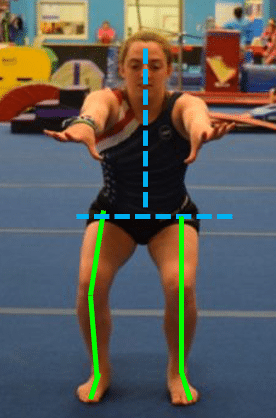
… feet around shoulder width apart, which widens the base of support over which force is exerted. Knees should be in flexion (bent), tracking over the toes …

Promoting Safety in Gymnastics: Landings

safest Gymnastics LANDINGS

Dave Tilley presented to both WAG NCAA College coaches and judges before the 2022 season.

The goal is for judges to evaluate landings consistently — and promote the safest possible landings.

The biggest reason is due to the massive number of serious knee and ankle injuries that gymnasts deal with, particularly in the NCAA. When you look at research studies, leg injuries account for up to 54.1% – 70.2% of all injuries.

Based on a study looking at injuries in NCAA Women’s gymnastics from 2009-2014, leg injuries accounted for 50% of all injuries with the knee and ankle being the most common (19). In some studies, up to 52% of all gymnastics injuries occur during landings, with some researchers calling it the ‘riskiest exercise phase in gymnastics.” …

THE NEED TO CHANGE LANDING DEDUCTIONS IN NCAA GYMNASTICS FOR LESS KNEE AND ANKLE INJURIES

Click through for a deep dive into this very important topic.

Watch William Emard STICKING.

Good aerial awareness. Stong legs. Good technique. Fewer injuries on landings.

Click PLAY or watch it on Instagram.

Gymnastics judge Jason Buttons interview

Excellent interview with expert WAG coach and judge Jason Buttons.

I was an age group MAG and FIG judge for decades. To me Jason’s feedback on the current state of U.S. judging rings true.

Those inexplicable mistakes sometimes made by NCAA judges are … plicable. 😀

Click PLAY or watch it on YouTube.

Kailin Chio – 3 x 10.0

In LSU’s win over Arkansas, Kailin competed 3 apparatus. Got 10.0 on each.

What a season she’s having!

World Gymnastics Women’s Artistic Newsletter – March 2026

  • Clarifications of the Code of Points 2025 – 2028
  • Clarification of the Youth Competition Programme
  • Personal equipment permitted on the Field of Play
  • Judges educational material
  • Updated Code of Points and Help Desk
  • WAG Code of Points 2025 – 2028 updates
  • New elements – January to December 2025
  • Table of elements
  • Symbol charts
  • List of names
  • 2025 World Championships Report (Jakarta)
  • 2025 Junior World Championships Report (Manila)

Bars – evaluating Double Layout

From World Gymnastics Women’s Artistic Newsletter – March 2026.

Stretch position must be maintained for the majority of the salto from the horizontal position (stomach down to floor) until the inverted position (consider when the legs are in the vertical)

screengrab

NCAA judging is a joke

I try not to worry about it. Ignore the scores (as much as you can) and look more at the ranking.

Surprisingly, this absurdly comic judging system often ends up getting the team ranks close to correct in time for the playoffs.