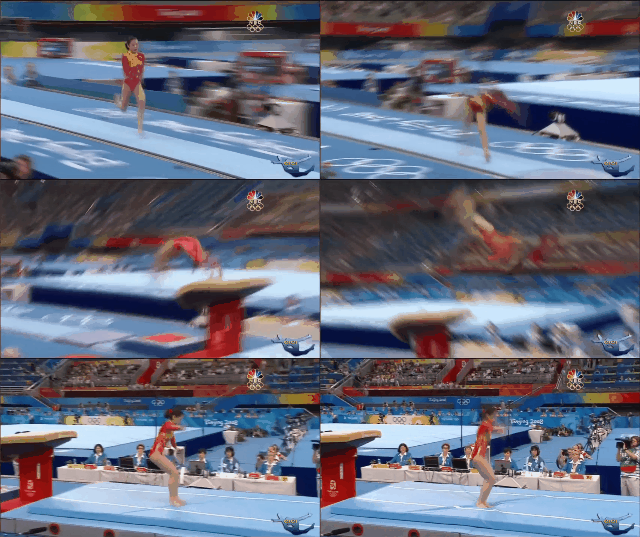
The more I watch this technique, the more I like it.
She should get some sort of bonus for straightening before landing.
Click PLAY or watch it on YouTube.
The more I watch this technique, the more I like it.
She should get some sort of bonus for straightening before landing.
Click PLAY or watch it on YouTube.
Their most recent skill in French.
Click PLAY or watch a teaser on Facebook.
The English translation will be released soon. Paid members (like myself) get access to both French and English versions.
3D FB-CURVES IOS app is free for 45 digital MAG skills. You can buy up to 800 MAG elements all values.
Cost for the package is $6.75 – $10.80 / month – no contract.
Click PLAY or watch it on YouTube.
Click PLAY or watch a sample on Facebook.
Click PLAY or watch it on Facebook.
That’s Brandon Burns who competed for Michigan. His stunts have had millions of views online.
Click PLAY or watch some of his variations on YouTube.
Interesting arm action.
Click PLAY or watch it on YouTube.
Click PLAY or watch what happened in the Olympic final on Twitter.
Olivier Rochon completed the most difficult skill in Korea, but did not land it cleanly enough to medal. He finished 5th.
Thanks Matt.
I really like the Gymnastics Canada WAG Aspire program for talented young gymnasts.
The Aspire Camps are great too.
You can check out the 2017-2018 ASPIRE PROGRAM MANUAL online for free, if you like.
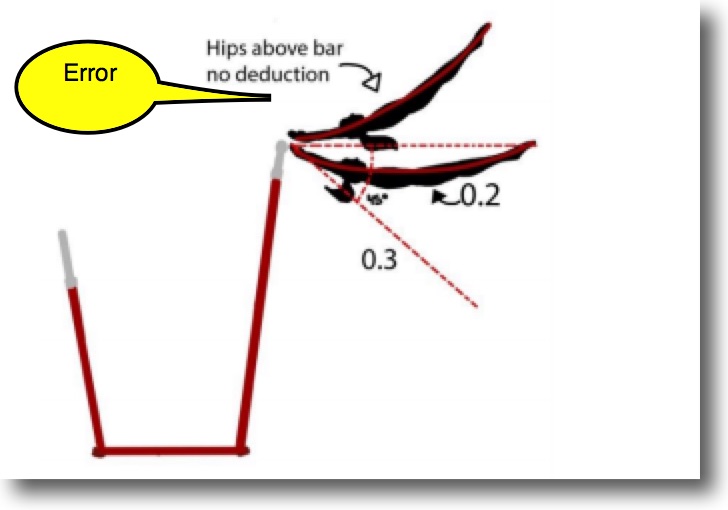
There is one error on page 15.
Of course the path of the Centre of Gravity starts tangent to the point of release. If you let go of the Bar when the C of G reaches horizontal you’d best be doing a Geinger.
If you release with hips above horizontal as required by that Aspire graphic there’s a very good chance you’ll land on the Bar.
The video linked from page 15 is correct, however.
The Centre of Mass must be below the Bar on release. Ideally with the hips below, the feet above as in this drawing.

The gymnast could apply a force to the Bar on release to either pitch-out or pull-in the Centre of Mass. Pulling-in can result in hitting the Bar.
related – G.S. George – Tangent-Release Principle
It’s usually a mistake to copy the technique of the best athlete that ever lived. What worked for Usain Bolt might not work for you. He became one of the best in the world with much less training than his competitors.
That said, this is an interesting video looking at technique and efficiency.
Click PLAY or watch it on Facebook.
Every release from any external-swing movement always results in
the center of mass being projected at a right angle to its radius.
If you release when the Centre of Gravity is as high as the Bar you go straight up, straight down. (e.g. Gienger)
There’s an interesting thread on Facebook on this topic.
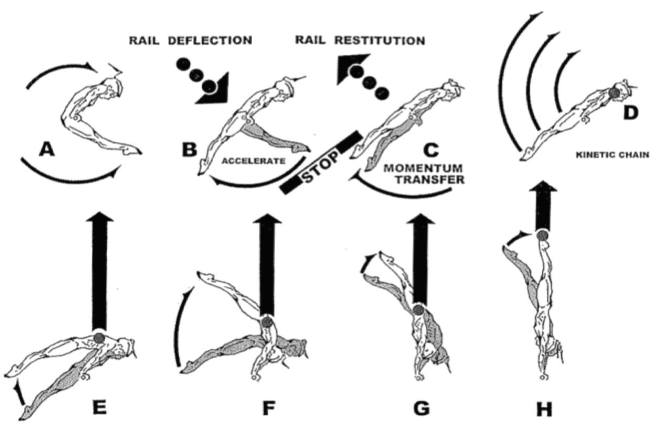
Most would consider cast handstand in a hollow / stretched position throughout as ideal. Nick Blanton mentioned this illustration from Championship Gymnastics.
It’s possible to do that technique. In fact it’s fairly easy on Parallel Bars as a swing handstand.
But I’m personally a very happy coach if the gymnast can lead with the heels (arch) to horizontal, then change the body position to hollow / stretched.
The ultimate would be perfectly straight through hips / trunk once leaving the rail. That’s difficult. The gymnast would likely be strong enough to do planche press without swing.
Of all the crazy deliberately off-axis round-offs or saltos I’ve seen, this is the wildest.
Click PLAY or watch it on Instagram.