physical preparation for injury prevention

Dr. Keith Russell is one of the smartest Gymnastics people I know

A former Canadian Men’s National Coach, personal coach of Olympians Warren Long and James Rozon, Keith is expert in anatomy, physiology, biomechanics and sports injury.

This is the first of a series of FIG Education online seminars organized because all regular FIG camps and clinics have been cancelled due to COVID-19.

One of Keith’s recommendations is to do fewer reps in our yearly training plans by working more strength / power and less muscular endurance. Especially for advanced gymnasts.

I recall Dr. Bill Sands stating a high level gymnasts should be able to complete all their strength / power training in about 30 minutes / day.

I like Keith’s simple graphics that help explain complex issues – knee ligament injuries, for example.

Click PLAY or watch it on YouTube.  (53min)

Here are some upcoming webinars.
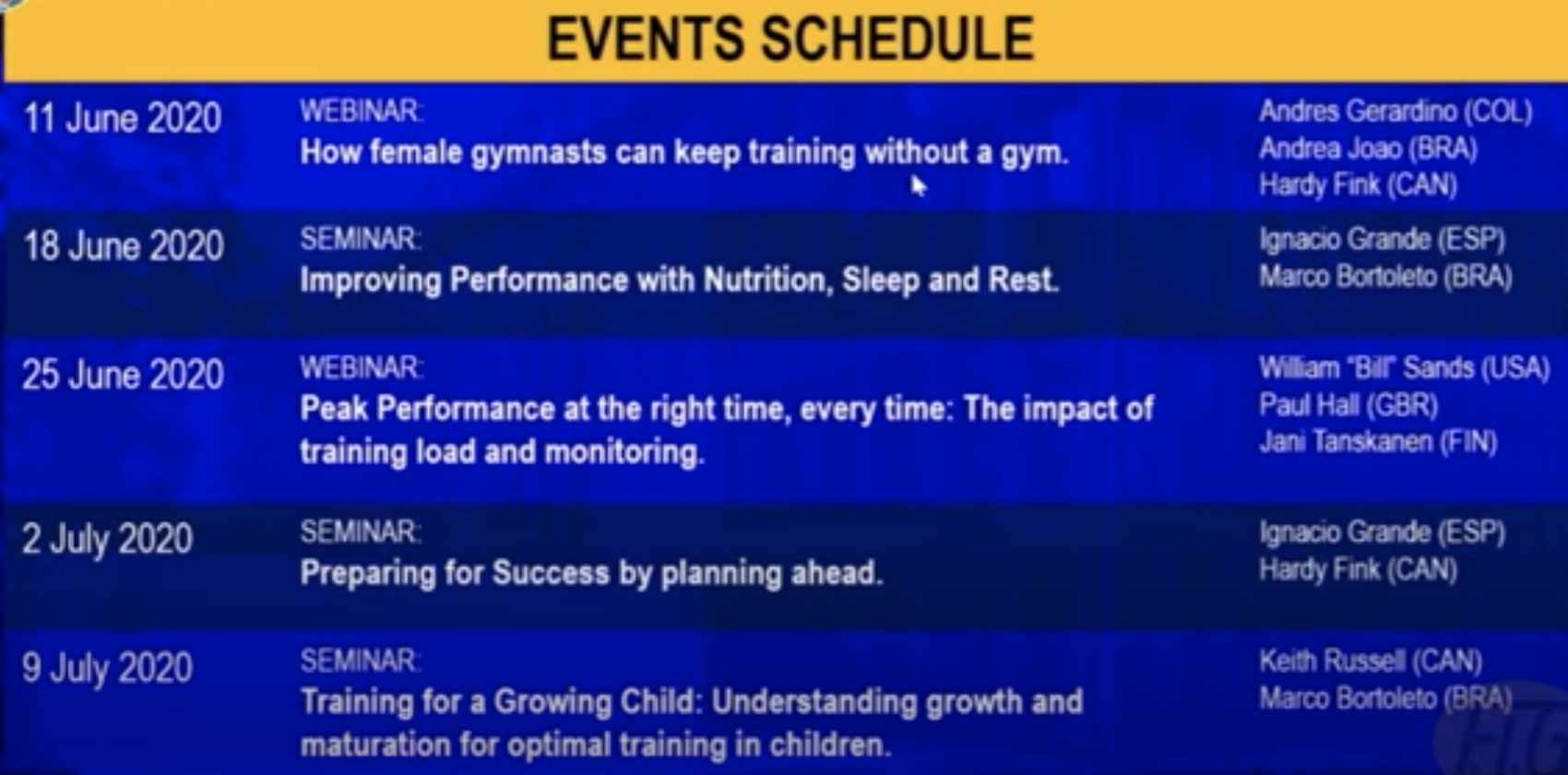
click for larger version of this screen grab

Free SHIFT Sports Medicine Clinics 2020

FREE to the first 100 registrants at each.

Travel, hotel, and food paid by participants.

Open to gymnastics coaches, gymnastics medical providers, and strength and conditioning coaches working in gymnastics.

University of Utah – Saturday, June 13th, 2020 8:30am – 5:00pm

University of Alabama – Saturday, July 18th, 2020 8:30am – 5:00pm

Details.

Dr. Dave Tilley is the organizer.

Expected topics include:

Building Healthy Training Cultures For Athlete Wellness and High Performance
Training Methods for Skill and Level Development
Gymnastics Strength, Conditioning, and Physical Preparation Methods
Gymnastics Flexibility Methods – Science Meets Practical Applications
Understanding, Preventing, and Managing Gymnastics Injuries
Gymnastics Mental Health, Recovery, and Nutrition
TBD based on participant topic request via survey


Transgender women in the Olympics

Obviously everyone has the right to compete in sport.

IOC must decide on rules. Enforce those rules.

There’s no perfect dividing line. It will take many years of fine tuning to get those rules as fair as possible.

Click PLAY or watch it on Facebook.

NormaTec PULSE 2.0 Leg Recovery

Bermuda Gymnastics Association has a NormaTec. The first I’d seen in person.

British Gymnastics is using NormaTec to boost circulation to the limbs, rejuvenate sore muscles, and reduce pain.

Click PLAY or see how it works on YouTube.

International Forum on Gymnastic Sciences

Toshiyuki Fujihara announces a big event in Osaka, Japan featuring …

Dr. Keith Russell, Dr. Gareth Irwin, Mr. Jeff Thomson, Dr. William A Sands, Mr. Huang Yubin, and Mr. Hiro Sato.

October 19-20, 2019.

No fee though you must register online.

For RECOVERY from exercise SLEEP is priority

Christie Aschwanden has a new book that’s getting a lot of attention, especially from coaches of endurance athletes.

The main takeaway for me was improving quality and quantity of sleep had the best potential for feeling more READY for the next training.

In one study a group of athletes spent 10 hours / night in bed, whether or not they were sleeping the whole time.

She found that many of the commercial products on the market had negligible effects on recovery. Often the placebo had the same result as the supposed recovery aid.

Recovery is very individual. And complicated.

She found that ice baths can “work” in that they make many athletes feel better (later), even if you’re not actually changing anything in the body.

Personally, I find the best strategy for the coach is to do an assessment of readiness to train at the beginning of workout, and adjust the plan based on that assessment. On a GOOD DAY do more. On a BAD DAY do more basics, less impact.

One season I had the girls do one rope climb during the warm-up reporting back to me how it felt. That was a good indicator, I found. We changed the load (e.g. tumbling reps) based on how they were feeling that day.

Amazon – Good to Go: What the Athlete in All of Us Can Learn from the Strange Science of Recovery

Christie Aschwanden is an award-winning science journalist.

She was the lead science writer at FiveThirtyEight for many years and is a former health columnist for the Washington Post. …

She was a high school state champion in the 1,600-meter run, a national collegiate cycling champion, and an elite cross-country skier with Team Rossignol. She lives and occasionally still races in western Colorado.

reducing Gymnastics leg injury

Dave Tilley:

Issues like stress fractures, ankle sprains, growth plate inflammation, ACL or meniscus tears, Achilles injuries, and overuse cartilage break down are seen throughout all levels of gymnastics. These injuries all have a common overlap in being “impact” based….

Click PLAY or watch it on YouTube.

On the upside, all that impact results in gymnasts having very dense bones.

On the downside, every coach needs to constantly assess the training plan to minimize the risk of traumatic and chronic injuries.

Dave has some advice.

1. Temporarily Reduce Workloads and Impact Volume

2. Diagnose and Get Medical Care Quickly

3. Be Patient

4. Manage Soft Tissue Daily (Manual Therapy and Stretching)

5. Use Ice Baths and Compression Nightly

6. Land Properly

7. Slowly Rebuild Knee and Ankle Joint Strength Following Injury

8. Slowly Rebuild Impact Volume Following Rehab

9. Correct Technical Issues (Steep Take off and Landing Short)

The other more obvious piece, although it’s shockingly not addressed, is that gymnasts simply need to stop landing short and destroying their ankles all the time. Mistakes obviously happen here and there, but the reality is that far too many gymnasts are being allowed to land very short on a daily basis. …

10. Build Leg Strength with Physical Preparation Programs

11. Track Growth

Click through for details and videos:

11 CRUCIAL WAYS TO COMBAT IMPACT KNEE AND ANKLE INJURIES IN GYMNASTICS

Gymnasts injured before arriving College

We have a very dangerous sport.

Thanks Greg.

College gymnasts – narcotic pain meds

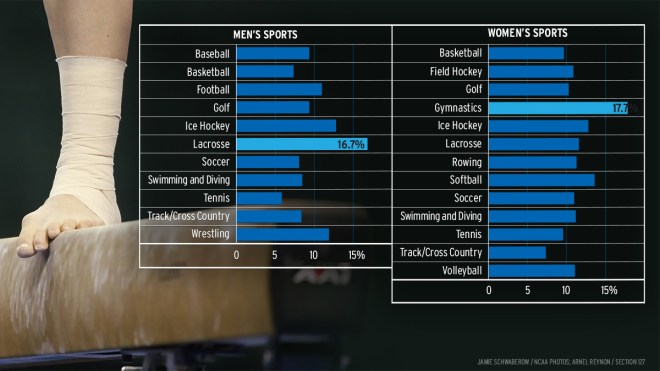
According to the recently released NCAA National Study on Substance Use Habits of College Student-Athletes, the proportion of women’s gymnasts who reported using narcotic pain medications — nearly 18 percent — is the highest among student-athletes in any sport.

Overall, the use of pain medication, both prescribed and nonprescribed, has decreased among student-athletes since the release of the last NCAA substance use study in 2014, but health care professionals still are examining how best to manage pain among college athletes. …

NCAA

Nassar abused his friend’s 6-yr-old

The criminal doctor’s victimized the daughter of a close family friend. It started when Kyle Stephens was age-6.

She was not a gymnast. This was not fake medical treatments.

Kyle’s father refused to believe her. As a result, she hated her father for years. They finally reconciled before his death.

Very ill, Kyle’s Dad took his own life in 2016.

Kyle Stephens was first to testify.

Listen to episode 8 online. But know that it’s disturbing.