There’s not much science in this short science video. No mention of centre of mass over base of support. No discussion on how forces are generated.
But they are big on suede. 🙂 (A suede-like fabric, actually)
Click PLAY or watch it on Twitter.
tumbling, tramp, diving, acrobatics, circus, cheer, dance, martial arts, X sports … and more
There’s not much science in this short science video. No mention of centre of mass over base of support. No discussion on how forces are generated.
But they are big on suede. 🙂 (A suede-like fabric, actually)
Click PLAY or watch it on Twitter.
Is a dive with 1.5 somersaults and 5 twists possible?
Some sport scientists believe it is but that a different arm action would be required. The body would tilt to the point of being near horizontal at one point before untilting for entry into the water.
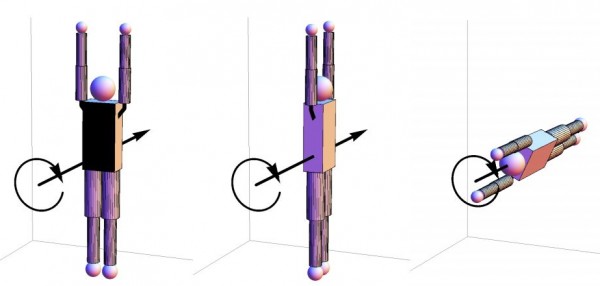
Read the study by WILLIAM TONG AND HOLGER R. DULLIN – A NEW TWISTING SOMERSAULT – 513XD (PDF)
related – Fred Yeaden – LEARNING HOW TO TWIST FAST (PDF)
(via Lukewiwa)
Click PLAY or watch it on Facebook.
(via Steve Bonham)
Watch how little she needs to move her arm in order to “tilt” a half twist.
Click PLAY or watch it on YouTube.
Working with a gymnast new to Shaposh recently, I was wishing we had a Quick Flex Bar. This is by far the best way for kids to get started on all counter rotating releases.
Click PLAY or watch it on YouTube.
The hands are the only point of force application. Of course that hip action is needed to put more weight on the rail. The equal, opposite and simultaneous reaction force is what generates the counter rotation.
Click PLAY or watch it on YouTube. 🙂
Now this is cool. Scroll down to see all kinds of graphics on our World Champion.

(via Chalk Bucket)
I’m at a coaching course right now. As always we spent disproportionate time on this skill
Dr. Bill Sands posted an article on the Biomechanics of Flyaway dismount on Bars. A good read for every coach.
I want to do EVERYTHING I can to prevent my gymnasts from hitting their feet on the rail. Or – worse – their head. 😦
Most dangerous, in my opinion, are tucked and double tucked flyaways. While changing position from the stretched long swing to the tucked position, there’s a chance the gymnast will “pull in” to the Bar. That is to say, redirect the path of the Centre of Mass towards the Bar.
That’s in addition to the normal problem – releasing too late.
What we WANT is a “pitch out” of the Centre of Mass. A redirection out and away just before release.

For me layout and double layout flyaways are safest. Then piked.
See it on The Advanced Study of Gymnastics – How Does a Flyaway Work? (link is now correct)
 Gymnastics Coaching.com