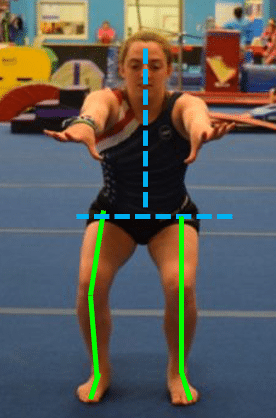
Dave Tilley presented to both WAG NCAA College coaches and judges before the 2022 season.
The goal is for judges to evaluate landings consistently — and promote the safest possible landings.
The biggest reason is due to the massive number of serious knee and ankle injuries that gymnasts deal with, particularly in the NCAA. When you look at research studies, leg injuries account for up to 54.1% – 70.2% of all injuries.
Based on a study looking at injuries in NCAA Women’s gymnastics from 2009-2014, leg injuries accounted for 50% of all injuries with the knee and ankle being the most common (19). In some studies, up to 52% of all gymnastics injuries occur during landings, with some researchers calling it the ‘riskiest exercise phase in gymnastics.” …
Though GAGE is a club that did many things right, the founder and head coaches are listed with the U.S. Center for SafeSport as “suspended from all contact” on its disciplinary database.
two-time European all-around champion (2024, 2025)
European Beam and Floor champion 2024
Before this controversy erupted online, I watched Manila win Floor — second on Beam — at European Championships 2026 in Zagreb last week. Against Russians.
At Men’s Europeans, it was AA champ Illia Kovtun who impressed me most.
With both these superstars, I can’t understand how and why they are so good. So consistent in competition.
Manila is very difficult for a judge to deduct. Her movements so fluid. On Beam she shares that kind of quality with Sanne Wevers & others of the Dutch system.
In 2026 some right wing politicians are protecting those who sexually abuse children, voting against safety bills or online privacy laws.
For example, Elon Musk’s Grok was used to generate non-consensual sexualized images and deepfakes of minors. Musk’s company, xAI, filed a lawsuit attempting to block a Minnesota law designed to penalize the creation and sharing of nonconsensual sexual imagery, including deepfakes of minors.
(FIG) World Gymnastics is proud to join the International Safeguards for Children in Sport network by taking the Safe Sport pledge and promoting safeguarding across all our disciplines. …
Safeguarding Roadmap 2028
Today, we are pleased to share our Safeguarding Roadmap 2028, developed with input from athletes, coaches, National Federations (NFs) and experts, and endorsed by the WGYM Safeguarding Commission and leadership. …
Governance & Regulatory: Establish an up-to-date, comprehensive and binding safeguarding policy framework for WGYM & NFs, with clear standards and accountability mechanisms.
Prevention & Education: Build a structured, scalable education ecosystem that equips athletes, coaches, NF officials and Safeguarding Leads with the knowledge and tools to prevent harm and respond appropriately.
Safeguarding Network: Establish and sustain a global network of Safeguarding Leads, covering all regions and the majority of NFs, each trained to serve as WGYM’s safeguarding partner at the national level.
Strategic Communication: Enhance safeguarding visibility – both internally and externally – and make WGYM a trusted and credible benchmark for safeguarding in sport.
I had input myself on this roadmap. The consultation process seemed to work well — and was surprisingly rapid. World Gymnastics has definitely put a lot of work into the initiative.
That said — children are not yet as well protected in sport as they should be.
Safeguarding is a work in progress.
🛡️ On International #SafeSportDay, we're proud to launch our first safeguarding newsletter and to join the International Safeguards for Children in Sport network by taking the Safe Sport Pledge.