Dora Meyers published an overview of NCAA women’s Gymnastics today. It’s doing very well. 🙂
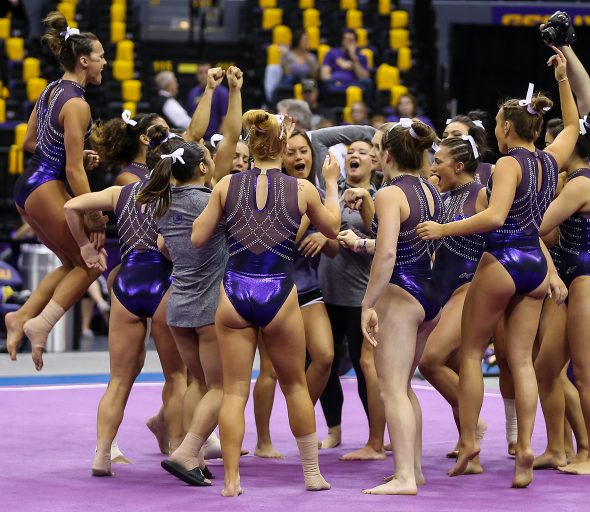
The joys of women’s college gymnastics, the best show on TV.
They’ll Tumble for Ya

tumbling, tramp, diving, acrobatics, circus, cheer, dance, martial arts, X sports … and more
Dora Meyers published an overview of NCAA women’s Gymnastics today. It’s doing very well. 🙂
Click PLAY or watch it on Instagram.
(via @GymCastic)
An electrifying performance by Kaytianna McMillan on the final floor routine gave No. 11 Oregon State a thrilling 196.550-196.525 victory over No. 4 Utah on Saturday in a Pac-12 Conference duel at Gill Coliseum. …
It also served as a perfect present for OSU associate head coach Michael Chaplin, who turned 50 years old on Saturday. …
BEAVERS TAKE DOWN NO. 4 UTAH IN DRAMATIC FASHION
I wouldn’t have gone 10 on this.
Click PLAY or watch it on Twitter.
Click PLAY or watch it on Twitter.
UCLA killed Bars today with 49.725. The third-highest in school history and the highest in 12 years.
This weekend I’m at the annual competition hosted by Altadore. It’s named for Ed Vincent who’s been with the club over 40 years.

CTV just named him Athlete of the Week. Watch an interview.
Click PLAY or watch Ed (age 78) in action on YouTube.
The competition was hosted for the first time at Grey Eagle Resort & Casino. The best venue ever, I’d say.
Tons of fun was the club’s 50th anniversary alumni reunion Friday night. There was much talk of the upcoming move to a new facility.
REPOST with comments from Dr. Bill Sands included.
… Utah’s gymnastics team was dealt its second major blow of the season when freshman Kim Tessen tore her Achilles last Saturday. Tessen had strung together a solid debut season and was coming off her best meet of the year before the injury.
Tessen’s season-ending injury follows up Sabrina Schwab’s season-ending ACL tear. …
Tessen is the fifth Red Rock to tear her Achilles in as many years. But Utah isn’t unique, as several other teams have watched athletes succumb to the same injury this season and over the years.
“I think last year we (NCAA teams) had 16 Achilles tears reported, and this year we are already at eight or nine,” said Farden. …
Utah gymnastics still focused despite second season-ending injury
Leave a comment if you have ANY idea how we might reduce the number of Achilles ruptures.
Read a thread on the topic on College Gymnastics Board.
William A Sands, PhD, FACSM:
The Achilles tendon injuries, particularly ruptures are complex. Having studied this problem for over 20 years, I believe there is a small constellation of causative factors working separately and together. However, prediction and prevention remain elusive. I have several presentations with high-speed video of athlete and spring floor interactions, but the files are quite large. I’ve presented at the USAG Congress on this very topic more than once. Seems like it always falls on deaf ears. Well, one more try…
James Linderholm alerted me to a recent discussion on Achilles tendon injuries. I saw a list of these injuries on Rick McCharles site. Below are some references to which you might want to refer when describing and discussing what is known about these injuries and some potential causative factors.
In my view, there are several potential causes, almost impossible to tease apart.
1. The wear-and-tear of long years of training is certainly a factor. Countermeasures for this include the use of ultrasound to examine the tendon and other local structures.
2. We can probably infer from a number of studies that injury incidence and rate are linked to body composition and anthropometry (ie weight and size). Countermeasures for this can include technique alterations, nutritional interventions, and reduction of training load.
3. Floroquinolones are known to cause problems with connective tissue strength and load characteristics. I will assume that most, if not all, sports medicine professionals are aware of this problem and no longer use these types of antibiotics. However, it may be worth a check to ascertain the role(s) of these medications, history of use, and so forth. The evidence, in my view, is pretty clear. Unfortunately, long-term use has not been investigated sufficiently for determination of whether historical use may cause problems. I’m not a physician, so please check with your team doctors.
4. Technique may be involved in that anecdotal discussions have indicated that athletes with low take-off impact angles may be more vulnerable. Most, but not all, Achilles tendon injuries occur during take-offs when ground reaction forces can exceed 15-22 times body weight. Work by Bruggemann and colleagues has shown that the bundles of the tendon are load differentially depending on placement of the feet, ankle and foot anatomy, and other factors.
5. The spring floor may contribute. I have made efforts for more than 20-years to study the spring floor and its relation to take-off injuries. AAI and Whitey Anson have been very generous in helping me work on this problem. There are some interesting aspects that are addressed in citations below, and on my website: http://www.advancedstudyofgymnastics.com. Interestingly, Achilles tendon injuries have occurred on coil spring floors and foam-type floors. I believe that the natural frequency responses (rates of vibration from depression to rebound) are not consistent between the gymnast’s lower extremities and the spring floor. Unfortunately, equipment companies must follow FIG specifications and I believe these specifications, while ensuring some uniformity in design, do not take enough account of biological factors. It is also interesting to note that when T&T coaches are queried about Achilles tendon injuries – these injuries are practically unheard of. Note that the tumbling apparatuses are very different from the artistic gymnastics spring floors. On querying T&T coaches I found that only one Achilles tendon rupture was recalled, and this athlete was a former artistic gymnast and approximately 35-years old. High-speed videography of T&T tumbling surfaces has shown that the lower extremity mechanics are quite different from those used on artistic gymnastics spring floors. T&T tumbling strips are simply more forgiving than artistic gymnastics spring floors.
6. EVERYONE wants to reduce or eliminate these injuries. I hope the information below will enhance discussions that lead to countermeasures that work.
… the newest Nike N7 brand athlete ambassador …
“I am humbled and grateful and am so excited to be able to help inspire the native youth to follow their dreams. I’m proud to be a part of this family.” …
All proceeds from the Air Native N7, which is sold through Native American community centers and tribes, are given back to youth sport and physical activity programs in Native communities across North America …
Ashton Locklear inks deal with Nike N7

October 2-8, 2017 – schedule
I attended all of Worlds 1985 Montreal and look forward to another terrific competition this year. 🙂 Just got my accommodations booked.
Tourisme Montréal anticipates 10.7 million tourists for Montréal’s 375th anniversary celebrations

Ashley Watson – triple back.
Click PLAY or watch it on Twitter.
 Gymnastics Coaching.com