An excellent piece of equipment if you train Double Mini Tramp in your Gym
Click PLAY or watch it on YouTube.

tumbling, tramp, diving, acrobatics, circus, cheer, dance, martial arts, X sports … and more
An excellent piece of equipment if you train Double Mini Tramp in your Gym
Click PLAY or watch it on YouTube.
Nearly 240,000 individuals are registered with USA Gymnastics.
The sport is strong in America leading up to the 2028 Olympics.
This is a reprint of an article of mine from back in the days of this logo. If this graphic looks familiar, you’re old. 😀
This twisting problem — Barani Confusion — is unrelated to that being much talked about right now — Simone Biles at the Olympics.

Many gymnasts have puzzling problems when learning twisting forward somersaults. Especially those who use a “contact” twist, from the floor, to initiate rotation around the long axis.
In this article I will try to answer some frequently asked questions concerning twisting. I’ll offer some suggestions to prevent the dread barani confusion.
What is Barani Confusion?
Confusion about the actual direction of twist on a Barani (forward somersault with half twist) is a real and common problem. Many gymnasts twist in the wrong direction when learning Barani; that is, a gymnast attempting to twist to the left actually twists to the right!
What Causes Barani Confusion?
Visual information when upside-down is disorienting — the perception is exactly opposite reality.
Try this experiment. Find a swiveling office chair and spin yourself around in circles. Compare your view of the floor with your view of the roof. Note that, relative to your point of view, the floor spins in the opposite direction than does the roof. (i.e. If the floor turns in the clockwise direction, the roof will turn in the counter-clockwise direction.)
It is no wonder that the gymnasts get confused. The visual information when upside down (looking at the roof) is reversed!
I’ve seen, sadly, some gymnasts learn Barani as a round-off with no hands. This is the worst possible progression. It usually results in Barani Confusion.
How can I be sure which direction the gymnast twisted?
When observing twisting skills watch whether the athlete turns chest or back to you during the first half twist. If the LEFT shoulder is moving backwards, it was a LEFT twist. And visa versa with the RIGHT shoulder.
This is a quick and easy way to determine whether the twist was initiated to the left or to the right, regardless of the complexity of the skill. With a little practice you can easily decide the direction of any twist at a glance.
There is no Barani Confusion for the observer.
Why does it matter which direction you twist?
1) Safety!
2) Skill Learning
It is important that GYMNASTS TWIST SALTOS IN ONLY ONE DIRECTION. We want no confusion to arise regarding which direction to twist while learning inverted skills. (Simple skills on the ground — e.g. Turns on Beam — can be safely done in different directions, of course.)
Do not allow a gymnast to twist in different directions on different salto skills. An athlete who can twist in both directions has no automatic response when learning complex, inverted twisting skills. An athlete indecisive about twisting direction may “freeze” or try to reverse a twist in mid-air. This is frustrating and can be dangerous.
Trampoline coaches are agreed on this point.
For me as a coach, the main problem skill is the Barani. Far too many gymnasts twist this skill in the wrong direction.
However, several other inverted gymnastics skills may be troublesome including:
• Round-off
• handstand pirouettes
• some beam combinations
• twist-on, twist-off vaults
• Tsukahara vault with twist
• Parallel bar dismounts with twist
The coach needs to be alert to ensure that gymnasts do not turn in the wrong direction! Twisting direction errors on these skills have baffled more than a few coaches … and judges!
After much consideration, my philosophy is to teach twisting skills in the SAME direction with one exception — round-off. Ideally, I want all gymnasts to fit in one of these two categories:
1. Right Twisters
– all skills twist to the right
– round-off twist to the left (right hand first)2. Left Twisters
– all skills twist to the left
– round-off twist to the right (left hand first)
There are exceptions in every gym, of course.
And there are advantages to twisting the round-off in the opposite direction to everything else though, admittedly, they are beneficial only for advanced gymnasts. For example, this approach is essential to do Kasamatsu vaults, and an advantage when tumbling out of backward layout 1/2, 3/2, or 5/2 twist on floor.
I have seen many advanced gymnasts who twist the round-off in the same direction as all other skills. Some top coaches even advocate teaching the round-off in the same direction as all of the other skills. However, the majority of coaches prefer the round-off to twist in the opposite direction.
Which direction should my gymnasts twist?
Almost everyone has “preferred” direction of twist based, most probably, on brain structure and function.
Try a number of creative and challenging contests turning in both directions to reveal a twisting preference. (Try not to let the kids know what you are assessing.)
Contest — turn in both directions. Check the preferred directions, if there is one.
Ask children to lie down on floor with the nose on the ground. On command, they stand-up, turn, and race for a line 5 metres away. Which way did they turn?
Ask the children to run in ever decreasing circles. Observe the direction of the turn. Try the other direction. Which direction looks more comfortable
Ask children to lie on their back on a mat and rock backward and forward 5 times. On the 5th rock turn over and do 5 rocks on the stomach.
Jump turn contests on floor landing on the feet — 1/2 twist, 1/1 twist, more?
Jump turn contests on floor landing into a crash pad — 1/1 twist, more?
If these contests reveal a strong preference, record that preference and post it on the gym wall. The direction of twist is decided by the coach, not the gymnast.
At the same time, the coach will be deciding on which hand will go down first on round-off.
Have beginners train cartwheels in both directions until they can do at least 5 in series. At this point it’s normally obvious which is the preferred hand for round-off.
For example, this girl is clearly better at cartwheels with her left hand first. (right twisting round-off)
Click PLAY or watch it on YouTube.
You may be doing a great service to your young gymnasts by ensuring that they learn to round-off in their preferred direction!
Should I try to CHANGE the direction of twist?
With young children, I have successfully changed the direction of twisting skills. Sometimes, it is frustrating for them. With older gymnasts, it is often better not to try to change twist direction. It may be easier, instead, to avoid certain problem skills. You must make these decisions on a case-by-case basis.
How can I avoid Barani Confusion?
I recommend that each club put in place a policy on twist direction, which must be communicated to EVERY coach, most importantly the pre-school and recreation instructors!
I post “Direction of Twist” monitoring sheets on the wall of the gym. I record the dominant twist direction for all of the gymnasts training twice / week or more. This helps prevent confusion and reminds gymnasts & coaches to be attentive to the direction of twist.
Lastly, I should state that I don’t ever teach the “Barani”. Instead I (and many other coaches) teach a forward somersault with a “late” half twist. I recommend this sequence of progressions:
Click PLAY or watch George Hery on YouTube.
• forward somersault piked
• forward somersault piked, and kick open
• forward somersault piked, open with late 1/2 twist (in correct direction)
• forward somersault piked, open with late 1/2 twist (in correct direction), jump half
• forward somersault layout with late 1/2 twist (in correct direction), …
Using this method you will rarely see the gymnast twist in the wrong direction.
 The pike-open prevents the gymnast from initiating the twist from the ground, which eliminates a number of problems including Barani confusion. Also, a “late” twist should be initiated when the gymnast can already see the floor — they are no longer inverted and, hence, no Barani confusion.
In Summary
For advanced gymnastics, I strongly recommend a solid groundwork in non-inverted trampoline skills. Once the dominant direction of twist is decided, the gymnasts should learn “roller”, “cradle”, “cat twist”, “cruise”, “corkscrew”, and many other fun and challenging non-inverted skills.
A gymnast with a solid foundation of twisting experience doing non-inverted, challenging trampoline skills are far less likely to accidentally twist in the wrong direction.
Trampoline is an excellent apparatus for training gymnasts. Be aware of the perceived and real risks, however. Coaches should be both certified and qualified at the appropriate level.
Good coaching!
Click through to see a print ready version including wall charts – Tramp – Barani Confusion (PDF)
Want more? Matthew Sparks posted the most sophisticated video summary of these issues: round-off, Kasamatsu, Tsuk 1/1, pirouettes, turning Giants, Diamadov, etc. Watch his video on YouTube.
Recommended Reading
C.G.F. (1992). Level 1 Trampoline Coaching & Safety Program. Ottawa: Canadian Gymnastics Federation.
C.G.F. (1984). Level 2 Trampoline Coaching & Safety Program. Ottawa: Canadian Gymnastics Federation.
Russell, K. (1986). Introductory Gymnastics — CGF Level 1 Coaching Manual (4th ed.). Ottawa: Canadian Gymnastics Federation.
Torg, J. S. (1987). Trampoline Induced Quadriplegia. Clinic in Sports Medicine, 6(1).
U.S.E.C.A./Women (1995). Video #64 Trampoline for Gymnasts USSR.
U.S.E.C.A./Women (1995). Video #75 Twisting.
Leave a comment or link if you have anything to add. This is
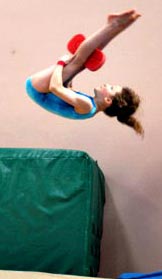
BIGGEST chance for injury is hitting the face on the knees. I always emphasize keeping the knees wide apart:
Click PLAY or watch it on YouTube.
Senior Men
GOLD Stanislau Yaskevich & Ivan Melnikau (AIN1) 52.520
SILVER Fabian Vogel & Matthias Schuldt (GER) 51.810
BRONZE Jordy Mol & Ralph Van Tilborg (NED) 49.190
Senior Women
GOLD Zlata Miniakhmetava & Katsiaryna Yarshova (AIN1) 48.790
SILVER Catarina Marianito Nunes & Sofia Correia (POR) 47.360
BRONZE Noemi Romero Rosario & Erica Sanz (ESP) 43.690
U21 Mixed
GOLD Maia Bochoridze & Tsotne Chkhaidze (GEO) 47.900
SILVER Ildan Makhiianov & Diana Strelnikova (AIN2) 47.880
BRONZE Mariyana Uzunova & Kaloyan Petrov (BUL) 46. 180
Junior Men
GOLD Yelizar Hutsau & Daniil Kirushkin (AIN1) 50.260
SILVER Carlos Martin & Manuel Oliva (ESP) 46.600
BRONZE Gleb Kuzichking & Grigorii Volkov (AIN2) 46.390
Junior Women
GOLD Kseniya Pabudzei & Kira Parcheuskaya (AIN1) 48.350
SILVER Sophie Darous & Alena Maio Tuna (FRA) 45.970
BRONZE Anna Syryn & Laure Mestdagh (BEL) 44.960
Senior Men
GOLD Oko Aikeremiokha (GBR) 30.300
SILVER Mikhail Iurev (AIN2) 29.800
BRONZE Timofei Golubenko (AIN2) 29.000
Senior Women
GOLD Alena Kalashnikova (AIN2) 25.900
SILVER Molly Mckenna (GBR) 25.600
BRONZE Kirsty Way (GBR) 20.200
Junior Men
GOLD Gabriel Arias (ESP) 28.000
SILVER Iaroslav Dushchenko (AIN2) 27.000
BRONZE Timofei Chigvintsev (AIN2) 26.100
Junior Women
GOLD Ava Parsons (GBR) 25.900
SILVER Paige Russell (GBR) 25.600
BRONZE Daria Khovansaia (AIN2) 24.900
Senior Men
GOLD Vasco Peso (POR) 31.400
SILVER Tofiq Aliyev (AZE) 29.300
BRONZE Magnus Lindholmer (DEN) 28.300
Senior Women
GOLD Lani Spiessens (BEL) 25.100
SILVER Alexandra Efraimoglou (GRE) 24.800
BRONZE Jaeda-Lei Jeffers (GBR) 23.200
Junior Men
GOLD Laurent Lommaert (BEL) 27.700
SILVER Frankie John Clark (GBR) 25.100
BRONZE Harry William Bingham (GBR) 24.500
Junior Women
GOLD Varvara Dorokhova (AIN2) 24.800
SILVER Emily Seaman (GBR) 24.400
BRONZE Liia Valieva (AIN2) 23.600
Senior Men
GOLD Ivan Litvinovich (AIN1) 65.310
SILVER Gabriel Albuquerque (POR) 64.240
BRONZE Kirill Kozlov (AIN2) 63.870
Senior Women
GOLD Anzhela Bladtseva (AIN2) 58.680
SILVER Iana Lebedeva (AIN1) 58.240
BRONZE Soffia Aliaeva (AIN2) 57.670
U21 Men
GOLD Fedor Sorokin (AIN2) 59.410
SILVER Bazhen Silin (AIN1) 57.290
BRONZE Remi Brochard (FRA) 57.610
U21 Women
GOLD Viktoryia Asiayuk (AIN2) 52.330
SILVER Anna Maria Mouratiada (GRE) 51.770
BRONZE Mariyana Uzunova (BUL) 51.580
Junior Men
GOLD Aleksei Gurin (AIN2) 58.410
SILVER Grigorii Volkov (AIN2) 58.090
BRONZE Daniil Kirushkin (AIN1) 57.610
Junior Women
GOLD Glafira Zaiko (AIN2) 54.330
SILVER Kseniya Pabudzei (AIN1) 54.290
BRONZE Nino Koridze (GEO) 53.050
Find the full results on the event website: 2026 European Championships in Trampoline, Double Mini-Trampoline and Tumbling – Portimao (POR) | European Gymnastics
Click PLAY or watch it on YouTube.
Freestyle Trampoline is an independent trampoline organization promoted by Greg Roe.
Many consider what they do as too dangerous — BUT European Gymnastics has reached out to include them at the recent 2026 European Championships hosted at Portimão Arena, Portugal.
I’m hopeful that Freestyle Trampoline will become increasingly organized. And that coaching becomes increasingly expert. For me it’s been too throw and go in the past.
Click PLAY or watch learn more on YouTube.

