
Former Chinese gymnastics team head coach Lu Shanzhen died of a heart attack at home in Beijing on Saturday, according to the Chinese Gymnastics Association (CGA).
Lu, 63, was well known for his excellence as a coach and for leading Team China to historical heights, including the first women’s World Championship team title in 2006 and first women’s Olympic team gold in 2008. …
Category: history
Kurt Thomas documentary
Kurt died unexpectedly of a stroke at age-64. What a shame.
If you don’t know his story, watch this entertaining new documentary. He was a cocky kid from a poor background.
Click PLAY or watch it on YouTube. (24min)
Tatiana Groshkova – double full-in, back-out
Click PLAY or watch it on YouTube.
some NAMED Bars releases
Click PLAY or watch it on YouTube.
History of the Pommel Flair
In honour of the late, great Kurt Thomas who made the Flair famous, I’m reposting some history.
Phillippe Delasalle from Canada was often credited for introducing the “Flair” after he showed it in international competition in Russia 1975. Soviets called it Delasalle for decades following.
Kurt Thomas unveiled his “Thomas Flair” variation (Flair Czechkehre Flair) in 1976.
Hardy Fink:
Naming of an element usually requires performance at a World Championship or Olympic Games. Both Philippe and Kurt performed it on the day of optional competition in the 1976 Montreal Olympics.
Canada did not have a full team so it competed early on that day. For that reason, Philippe performed it many hours before Kurt.
All of the Eastern bloc and many other countries referred to it as the Delesalle for many years. But the name Thomas flair eventually won the “name recognition” war and that is how it was entered in the Code of Points several years later.
Most agree it was Ted Marcy and others from Hinsdale High School in Chicago who invented the Flair.
Donny Gardiner who was on the Hinsdale team back then recalls “the guys” playing around with different ideas to transfer from circles into pendulum swings. It was a ‘scissor break’ that evolved into the Flair over time.
(Donny recalls that Marcy was the first they knew of to reach vertical on scissors, as well.)
Todd Gardiner, Donny’s brother, recalls that Ted did the ‘Marcy flair‘ in High School competition which consisted of just the split into scissor break. By college (1972) Ted was probably training full flairs, but Todd’s not sure when (exactly) he first competed them. One competitor from those years cannot recall Marcy ever competing a full flair.
However, at the Midwest Open in either ’74 or ’75 Ted competed against Hoffman & Slezak from Hinsdale, among other greats, and fell very early in the routine. As Midwest didn’t allow for a remount, Ted smiled, saluted, then got back up and threw a fun routine including an exaggerated full Marcy Flair and other wild stuff. The crowd went nuts.
Click PLAY or watch some Collegiate Championships 1976 on YouTube. A number of the competitors use variations of scissor break and Flair. Ted competed for Stanford.
Joel Ulloa who ended up competing for Cal State Fullerton was working on Flair in the ’70s too. You might recall the IG magazine photo sequence of the ‘Ulloa Break’.
So who invented the Flair?
I’m guessing the first full Flair was most likely done first at Hinsdale by 1972 or 1973. In training. At the time Ted Marcy was the best of the guys playing around with it. Hoffman and Slezak may have competed a full Flair even earlier in local competitions.
Kurt Thomas photos
In tribute of America’s first male Gymnastics superstar, International Gymnast magazine posted some of their photos on one gallery page.
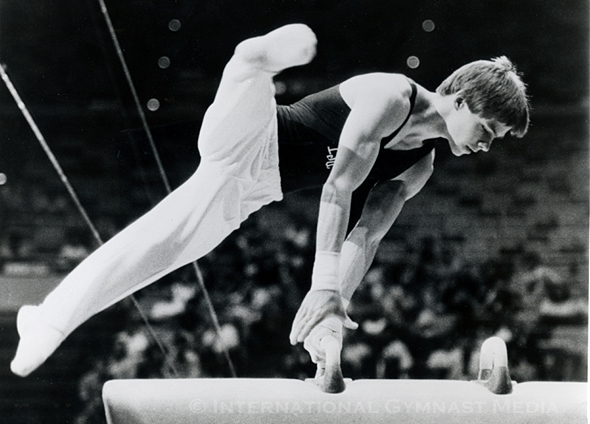
Kurt Thomas – 1978 Floor World Champion
Click PLAY or watch it on YouTube.
Kurt Thomas R.I.P.
I can’t believe it.
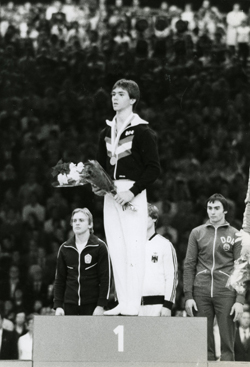
Kurt Thomas competed for Indiana State University; where he was a five-time NCAA champion, winning the parallel bars and all-around in 1977 and parallel bars, horizontal bar and the all-around in 1979. Thomas helped lead the men’s gymnastics to the 1977 National Championship.
An Olympian in 1976, Kurt was the first American male gymnast to win a gold medal in floor exercise at the 1978 Worlds.
His name lives on as many of us still call Flair Czechkehre Flair a Thomas.
“I am completely devastated to hear this”, said Olympic teammate Bart Conner.
“Kurt was a fierce rival, who went on to become a cherished friend.
My heart is breaking for his wife Beckie, his children, Hunter, Kassidy and Kurt as well as the entire gymnastics community, who lost a true pioneer today.”
IG – World Champion Gymnast Kurt Thomas Passes Away After Suffering Stroke
timeline of new Vaults
Here are SOME of the early performances of new vaults. Don’t consider it definitive.
Click PLAY or watch it on YouTube.
Gymnastics Canada celebrates gymnasts, coaches, judges
Click PLAY or watch it on Facebook.
 Gymnastics Coaching.com