Details on People magazine. Ignore the sensational title of that post.
Her husband was offered a job in Florida and the family decided to move.
I’m sure these two will be very close for life.

tumbling, tramp, diving, acrobatics, circus, cheer, dance, martial arts, X sports … and more
Details on People magazine. Ignore the sensational title of that post.
Her husband was offered a job in Florida and the family decided to move.
I’m sure these two will be very close for life.
by site editor Rick McCharles
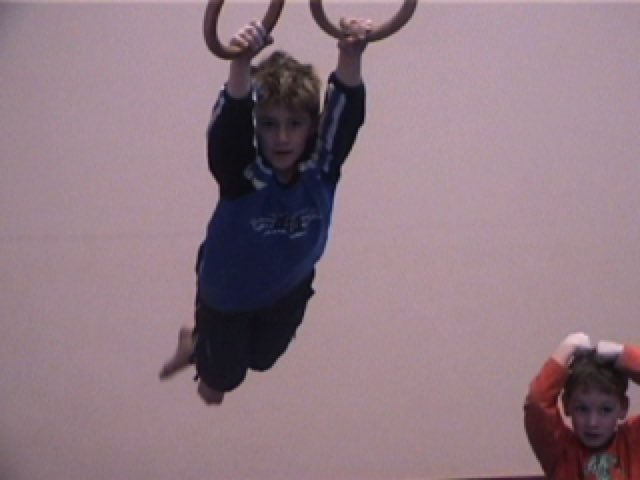
Many excellent girls Gymnastics clubs underserve boys in their market. Brothers are sitting in the parents seating area – restless – waiting on sisters. That’s a waste.
The best boys Gymnastics clubs have as high a ratio as 1 boy for every 3 girls. That kind of ratio is possible.

First priority for boys coaches is increasing the base. Increasing the numbers of boys trying Gymnastics and other acrobatic sports.
Once in the Gym many will find they like the sport. It’s FUN. Keep it FUN.

Boys love Games, Contests and Challenges. Most boys love height and flight. Excitement.

Once hooked on the sport, next priority is improvement of Physical (Endurance, Stringy, Power, Flexibility, etc.) and Motor (Agility, Balance, Coordination, Spatial awareness, etc.) fitness.
Skills are lower priority than for girls the same age.
Role models are important for boys. It’s important coaches and the eldest and most advanced boys in the club be leaders.
Clubs who do want to increase the size and quality of the boys Recreation program have two major problems:
There are far fewer boys coaches available than girls coaches. Some serious effort may be required to recruit and train boys Rec coaches.
In 2016 Parkour / Ninja classes are very popular with boys. Boys parents are very keen to keep their sons doing Parkour safe.
Once in the Gym some of those Ninja boys will get interested in the Artistic competitive apparatus.
I like “bring-a-friend” day, as well. Check the insurance implications of bringing in a friend to your Gym.
related – Gymnastics Ontario Congress 2016 – BUILDING A RECREATIONAL BOYS PROGRAM – presentation notes PDF
(via Rec Gymnastics)
Despite a disappointing Olympic Games in Rio de Janeiro, Romanian veterans Cătălina Ponor and Marian Drăgulescu aren’t planning on retiring any time soon. Their immediate goal is next year’s European Championships, taking place April 19-23 in Cluj-Napoca.
The duo told Romanian media they have their sights set on continuing toward the 2020 Olympic Games in Tokyo, which would be Ponor’s fourth Olympic appearance and Drăgulescu’s sixth. …

Are the figures on the numbers inspired by Nadia and Marius Urzica?
😦
Margarita “Rita” Mamun is our individual Rhythmic Olympic champion.
On 26 August 2016, Rita’s father Abdullah passed away after battling with cancer for the last few months, he died bed ridden at their home Friday afternoon (Moscow time), just 6 days after she won gold at the Olympic Games.

related – Rhythmic gymnastics: Mamun hails victory for ‘two countries’
Acro was accepted by the International Olympic Committee (IOC) Executive Board as a new discipline for the 2018 Youth Olympic Games at the board’s recent meeting in Rio de Janeiro (BRA). The third edition of the Youth Olympic Games will be held October 1-12, 2018 in Buenos Aires, Argentina.

Many want to know how the Brits are doing it. And it comes down to one thing: money. …
the money the athletes receive themselves (aside from endorsements). Olympic athletes in Great Britain receive about £36,000 to £60,000 a year from UK Sport, the national funding initiative for Olympic athletes. This allows them to focus on training for most of years leading up to the Games.
Comparatively, Canadian Olympic athletes receive a paltry $18,000, and it hasn’t changed since 2004, making it a challenge for competitive athletes.
“It’s just crazy to me that funding hasn’t increased in more than 10 years,” said Josh Riker-Fox, a retired modern pentathlete who competed at the 2008 Beijing Olympics. …
Rio 2016: Why Britain is dominating the Olympics and what Canada can learn
Thanks Karl.
Click PLAY or watch a montage on YouTube.
The last time the Olympics were held in Tokyo.
Click PLAY or watch it on YouTube.
At the 1964 Summer Olympics in Tokyo Shuji Tsurumi received a gold medal in team combined exercises, and silver medals in individual all-around, pommel horse, and parallel bars.
(via Gymnastics Lab)
There’s not much evidence that Elastic therapeutic tape (KT Tape) works. But if an athlete believes it works, there might be some benefit.
Click PLAY or watch it on YouTube.
 Gymnastics Coaching.com