
Host France 🇫🇷 take 5 golds at World Challenge Cup in Paris
👉 https://t.co/diJibSqgbE
📷 FFGym / Michael Motz pic.twitter.com/oSx3YlYFR3— FIG (@gymnastics) October 1, 2018
definition – “density” of training
In Canadian coach education, for gymnasts, we’ve used …
Density is the Number of elements (skills)
divided by Number of attempts
Density goes up over the season. In the preparation phase an athlete might do 60 elements in 60 approaches to the apparatus.
Mid-season you might do 60 elements in only 15 turns. Warm-up then 8 half routines, for example.
During the highest density part of the season on a hard day we’ll do many full routines in the same period of time. But with longer rests between routines. Perhaps 60 elements in 8 touches of the apparatus.
During the taper before competition density drops rapidly along with volume and intensity. A low density workout might be hit 2 routines. Long rest between.
Note: this example ignores difficulty and complexity of the 60 elements.
___
Here’s another example from (easier to monitor) strength training – doing the same amount of work in less time.
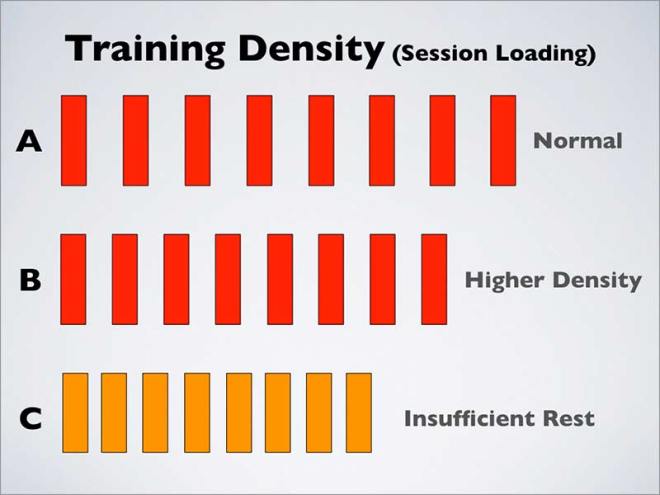
The goal would be to see a greater training effect by eliciting stronger signaling to the body.
Of course if you decrease the rest-to-work ratio between sets too much you risk poor technique and/or injury.
Therefore you’d need to experiment with decreasing rest periods gradually over time. More fit athletes will be better able to handle it sooner.
Increasing density would only be done at certain times of the year, certain apparatus and on hard days.
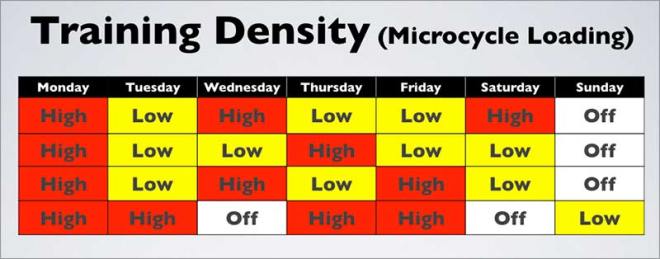
Of all the classic periodization variables and principles of training, the density of training is the least clear in the scientific literature …
Decreasing time while doing the same volume is a common approach to manipulating density, but during taper periods or recovery phases sometimes coaches do the opposite and pace slower. …
A healthy perspective is to save training density programming until everything is in place and the athlete needs to advance …
Note that many coaches don’t use density as one of their variables in planning. For most of my career I’ve found volume and intensity to be enough.
promoting Gymnastics for boys
Gymnastics Queensland
Click PLAY or watch it on Facebook.
climber Andrea Maruna
One of Outside’s World’s Best Adventure Photo Contest winners.

Rebecca Andrade – Rio Floor
Click PLAY or watch it on YouTube.
push-ups to finger tips
some thoughts on effective practice
Click PLAY or watch it on Facebook.
Thanks Jamie.
Jordan McNair died practicing football
On May 29, 2018, University of Maryland lineman Jordan McNair ran the last sprint of his life. After a series of 110 yd runs, during which he became disoriented and had trouble standing, McNair collapsed and died of heat stroke. He had a body temperature of 106 degrees in the hospital. He was only 19.
What happened? Why did it happen? Should this have ever happened? Were any individuals negligent and responsible for this tragedy? These seem to be questions that should have been asked by the administration of Maryland, yet were they? Because it was not until an August 10 report by ESPN that the university started holding coaches and staff accountable. …
Aside from very frequent brain trauma, American football has always had many deaths on the field of play.
One study counted at least 49 deaths related to football in 1931. It’s always been an extremely dangerous sport. 1965 had a similar number.
Bottom line – American football is still too dangerous.
Thanks @GymCastic
excellent training montage
Click PLAY or watch it on YouTube.

