Region 5 gymnasts talk about surviving pandemic uncertainty and the lessons learned through adversity.
Click PLAY or watch it on YouTube.

tumbling, tramp, diving, acrobatics, circus, cheer, dance, martial arts, X sports … and more
Region 5 gymnasts talk about surviving pandemic uncertainty and the lessons learned through adversity.
Click PLAY or watch it on YouTube.
Wayne Smith is one of the most thoughtful and outspoken pundits on coaching.
Coaches and Officials – more than anyone else – are directly responsible for whether your sport succeeds or fails.
Coaches and Officials can be powerful and effective advocates for all the wonderful things your sport has to offer.
And they can be just as influential in contributing to the demise and even complete destruction of your sport.
So the question is: Are your coaches and officials Spoiling Sport or Selling Sport? …
New Sport Future
She wants to move on.
College Gymnastics not everything she hoped.
Click PLAY or watch it on Instagram.
Music by John Legend.
She’s one of 6 Olympic athletes talking about overcoming social pressures to achieve success.
Click PLAY or watch it on Twitter.
Click PLAY or watch the full trailer on YouTube.
Nia and Gabby were teammates at Buckeye.
GABBY DOUGLAS: I’m so happy for you, Nia! Shout-outs from Michelle Obama, Missy Elliott, and Alicia Keys?
NIA DENNIS: It’s crazy. This feels like a movie. It’s surreal. …
Nia Dennis Talks to Gabby Douglas About the Pressure of Being Perfect
Click through to Interview magazine to read the conversation.

Luba says Valentina was atypically nice and lucid during Europeans. 😀
Of course Russia had a great meet.
Q: Did this competition decide the Olympic team’s roster?
A: We have Nagornyy, Belyavskiy, and Kartsev here who will sure be on the team, although no one’s safe from injuries. But Kartsev for now is among these four, same as Dalaloyan whose recovery we’re counting on. Even if Artur won’t be able to compete on all six events – his signature events are floor and vault – we’re still take him for four events. …
Q: It’s hard to understand how ready are the American, Japanese, Chinese gymnasts now. There are no competitions and there’s very little information about the rivals.
A: Have you seen Biles? What is there even to say? She’s 70% of the American team, you remove her and we will easily beat them. …
RODIONENKO: REMOVE BILES AND WE WILL EASILY BEAT THE US TEAM
In a 3-up, 3-count Olympic team final, consistency could be more important than start score.
USA has been the most consistent under pressure for many years. I don’t see that changing in Tokyo.
Also, every coach knows it’s bad strategy to motivate your competition with statements like this.

Every Olympics … traditional media pays attention to Gymnastics.
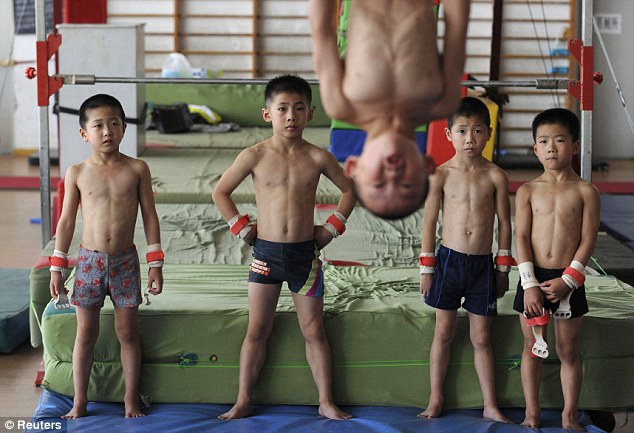
Every Olympics you can predict stories from China featuring very young kids crying and being overstretched.
Tokyo is coming up.
Yet this story from the Li Xiaoshuang Gymnastics School says the focus is now on fun for the children — “happy gymnastics” — rather than the medal-obsessed ways of old.
I hope that’s true.
Thomas Curran and Andrew Hill’s meta-analysis of rates of perfectionism from 1989 to 2016, the first study to compare perfectionism across generations, found significant increases among more recent undergraduates in the US, UK and Canada.
In other words, the average college student last year was much more likely to have perfectionistic tendencies than a student in the 1990s or early 2000s. …
The Dangerous Downsides of Perfectionism
Perfectionistic tendencies have been linked to clinical issues: depression and anxiety (even in children), self-harm, social anxiety disorder and agoraphobia, obsessive-compulsive disorder, binge eating, anorexia, bulimia, and other eating disorders, post-traumatic stress disorder, chronic fatigue syndrome, insomnia, hoarding, dyspepsia, chronic headaches, and, most damning of all, even early mortality and suicide.
Social media has likely compounded some of those problems.
SO — coaches should not encourage kids to be perfect.
Thanks Steve.
 Gymnastics Coaching.com