In slow motion.
It’s much tougher to STICK than they make it look.
Click PLAY or watch it on YouTube.
Thanks Jeff.
tumbling, tramp, diving, acrobatics, circus, cheer, dance, martial arts, X sports … and more
In slow motion.
It’s much tougher to STICK than they make it look.
Click PLAY or watch it on YouTube.
Thanks Jeff.
After Rebeca scored 9.733 execution on what many would consider a perfect Cheng, there has been discussion online. 😀
ALL agree that FIG judges in 2023 “box” the execution scores too much. The difference between best and worst is not accurately reflected by differences in E score.
Judges do this in order to stay in range, and not get in trouble from the FIG WTC.
Personally, I’d like to see the rare 10.0 execution score. (Certainly there are too many in WAG NCAA, some obviously not even close to being deserved.)
IF the performance is significantly superior to anyone else in the world — and there are no obvious deductions — it should get a 10 execution score.
I’ve seen several P Bar routines from Zou Jingyuan where I would have NO DEDUCTIONS recorded on my judging sheet. For example.
I can’t stop watching this Vault.
In regular speed I’d have to award a 10.0 Execution score.
Click PLAY or watch it on YouTube.
We have to start ranking Rebeca’s Cheng from PanAm Vault Final 2023 with the BEST Vault of all time. #respect
At PanAms, Costa Rican gymnast, Andrés Valverde, used what you might call Double Layout over the bar with double twist.
A single twist is named for Dan Hayden.
The Valverde is a dismount I’ve never seen before. Should be a new element in the Code of Points.
Note – Andrés competed in Santiago only 7 months after Achilles surgery.
Click PLAY or watch it on Instagram.
The BIGGEST problem with Artistic Gymnastics judging is the Execution Score range between best and worst.
That range is too small — therefore it’s mostly Difficulty Score that decides ranking.
This article doesn’t address the BIG issue, but it is interesting to see how FIG is evaluating their judges.
Dr Hugues Mercier speaks exclusively to Olympics.com about his 10-year project that evaluates judges’ performance in disciplines such as artistic and rhythmic gymnastics. …
“Judging a routine in pommel horse is intrinsically much more difficult than judging a routine in vault, and it’s very important for the tools we provide to be fair. So, I always tell the judges that the mathematical tools that we use take into account that judging in pommel horse is difficult.
“So, on a 7.5 routine, which is a good routine on pommel horse, a judge who makes an error of, let’s say 0.3, 0.4 is completely normal. In vault, giving 9.5 instead of 9.1, it’s a very, very, very large error… it’s an outrageous difference. So, this is all scaled, so that when we analyse the accuracy of judges, we take into account the apparatus on which they judge.” …
Olympics.com

Every other team had no more than five.
SUBSCRIBE to this YouTube channel to support men’s Gymnastics.
Click PLAY or watch it on YouTube.
I’d say it was a fall during her Team routine.
SAFER is to do the hip circle out.
Click PLAY or watch it on YouTube.
I attended the press conference at Antwerp Worlds.
The Judging Support System (JSS) is available on all 10 apparatuses. Only 7 were ready last year in Liverpool.
They are using 4 cameras on each apparatus. Eight on Floor.
Donatella said it’s only being used in case of appeal. She showed 2 good examples of how it could work:
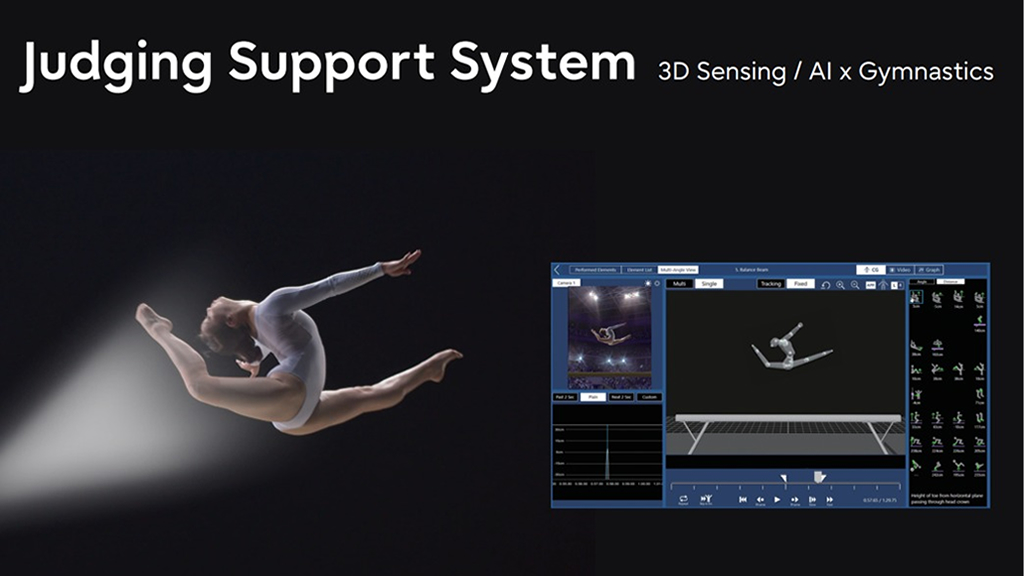
By clicking icons on the right, a judge can check height, distance, angle, etc.
She explained it’s only being used for D-score credit at this point. Not Execution.
Donatella is looking forward to checking the D-judges after the competition using JSS. Useful for judge training.
Arturs Mickevics, the Men’t Chair, agreed that the technology works and will be useful.
Recall we’d previously seen that it’s super accurate evaluating Rings strength holds and angles.

President Watanabe was the most effusive. He wants judging that is more fair and transparent.
Personally, I was keen to find out how soon coaches can get an app for feedback in training. No timeline on that. In case of injury, we’ll be able to evaluate the athletes — and see when they get back to baseline height, distance, etc.
Fujitsu’s plans to launch something called their Human Motion Analytics platform in April 2024 which might be something that can aid in the TRAINING of gymnasts.
Of course they want graphics to be instantly available for video broadcast, as well. No timeline on that.
Aesthetically, FB CURVES 3D GYM is still far more appealing. It’s an entirely different product, of course. But still far more useful for coaches in 2023.
Click PLAY or watch it on YouTube.
The BEST of the JSS video we were shown was close to FB Curves 3D, but more human. Less perfect.
Of course it’s inevitable that all the recorded data will eventually be fed into AI platforms. It will be interesting to see how good the resulting AI VIDEO interpretations will be.
Click PLAY or watch it on YouTube.
Unless you are AWESOME.
 Gymnastics Coaching.com