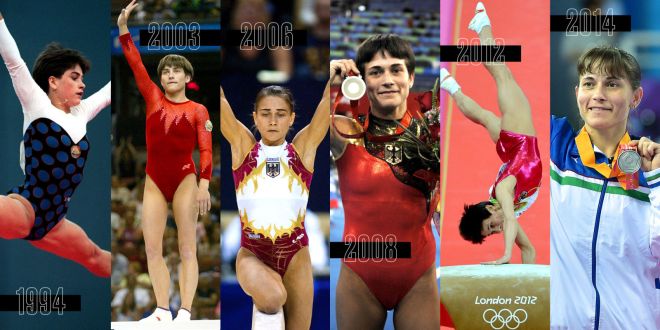
Oksana:
“I will retire on Monday. I cannot tell you months, days, or years, but it’s going to be a Monday.”
How This 41-Year-Old Got to Rio—and Became the Oldest Competing Gymnast in History
tumbling, tramp, diving, acrobatics, circus, cheer, dance, martial arts, X sports … and more
Oksana:
“I will retire on Monday. I cannot tell you months, days, or years, but it’s going to be a Monday.”
How This 41-Year-Old Got to Rio—and Became the Oldest Competing Gymnast in History
Interesting.

I’m reading The Sports Gene. One section talks about how athletes do not feel pain during extreme sports focus.
by site editor Rick McCharles
This book was written for the general public. They like it.
But as a coach I still enjoyed it. To revisit the history of the Code was a good catch-up in advance of Rio.
Dvora provides balanced perspective on the pros and cons of eliminating the iconic perfect 10. She interviews many of the important players on the world scene including Hardy Fink, the primary architect of the current Code. Hardy’s not happy with how his original proposal was changed over the years. But feels eventually it will work as intended.
New to me was the revelation that Bela Karolyi did not discover Nadia on the playground. Another part of the great Karolyi myth.
By the end of Perfect 10 I redoubled my conviction that giving up the perfect 10 was a HUGE mistake. We’ve never been much good in marketing the sport. A great salesman like Steve Jobs would conclude that the perfect 10 was our greatest and most valuable asset.
The NCAA women’s program got it right. It’s more important to fund gymnasts through University and keep coaches employed than to exactly rank the very best of the best perfectly.
That said, FIG will never go back to the perfect 10.
But I’d love to see them add something like a “Ranking Score” on top of the current system.
Each quadrennial, on each apparatus, a 10 would be set in advance.
For example on WAG Floor it might be 17.0. If Simone scored 16.5 her Ranking Score would be 16.5 / 17.0 = 9.70.
YES it might be possible to exceed the perfect 10 under this scheme. Fans would love to see a 10.100. 🙂
I bought the audio version. The audio book reader – Elise Arsenault – is poor. Not professional enough to check the correct pronunciation of names in a nonfiction work. She calls Marta Karolyi “Martha“, for example. 😦
related reviews:
• Slate – A Perfect 16.223
• Meghan O’Rourke – Why Extreme Gymnastics Will Dominate the Rio Olympics
• FloGymnastics – Q&A with Dvora Meyers
1996 Olympic trials. Two hop 1/1s in series.
Click PLAY or watch it on YouTube.
via REGION 5 ELITES WHO CHASED OLYMPIC GLORY: KATIE TEFT, TWISTARS USA
I mean the Biles.
Click PLAY or watch Trinity on Instagram.
Click PLAY or watch London Phillips on YouTube. (2005)
London never competed it at a major FIG Championships so it was not named after her.
(via papaliukin)
The Skating Lesson continues their series of Gymnastics interviews with 2004 Olympic Gold Floor medalist Kyle Shewfelt. Clearly TSL are picking and choosing whom they want to speak with. 🙂
Kyle likes Gabby over Aly for the AA. He slightly prefers Maddie over Ashton on Bars.
And he feels some scores at the American Olympic trials are up to 0.3 too high.
Click PLAY or watch it on YouTube. (68min)
Defending Olympic Champions from 2012. A reminder of who will have a chance to repeat the glory. I crossed out the names that won’t be in Rio.
MAG
TF: China
AA: Kohei Uchimura
FX: Zou Kai
PH: Kristián Berki
SR: Arthur Zanetti
VT: Yang Hak Seon
PB: Feng Zhe
HB: Epke ZonderlandWAG
TF: USA
AA: Gabby Douglas
VT: Sandra Izbasa
UB: Aliya Mustafina
BB: Deng Linlin
FX: Aly Raisman
Click PLAY or watch it on Facebook.
Heart this photo on Twitter.
A new FIG profile piece. Narrated by Blythe Lawrence.
Click PLAY or watch it on YouTube. (12min)
(via papaliukin)


