The second trial is September 15th.
1. LI Shijia 58.533
2. LIU Tingting 57.567
3. ZHANG Jin 56.833
After the meet Chow asked gymnasts to hug their coaches.
The second trial is September 15th.
1. LI Shijia 58.533
2. LIU Tingting 57.567
3. ZHANG Jin 56.833
After the meet Chow asked gymnasts to hug their coaches.
This is a reprint of an article of mine from back in the days of this logo. If this graphic looks familiar, you’re old. 😀
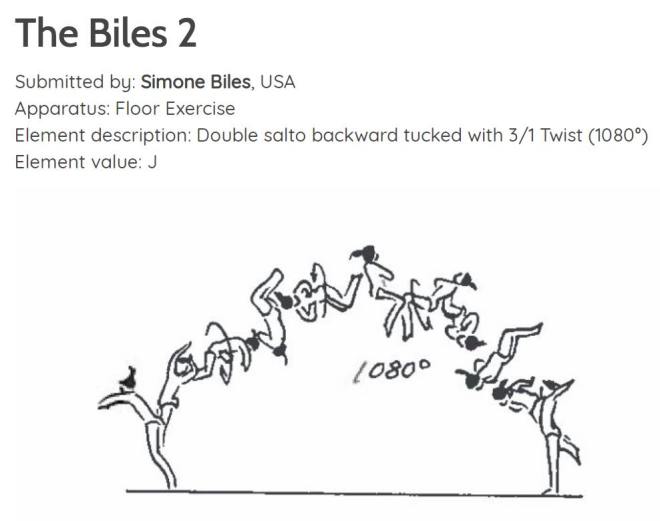
This twisting problem — Barani Confusion — is unrelated to that being much talked about right now — Simone Biles at the Olympics.

Many gymnasts have puzzling problems when learning twisting forward somersaults. Especially those who use a “contact” twist, from the floor, to initiate rotation around the long axis.
In this article I will try to answer some frequently asked questions concerning twisting. I’ll offer some suggestions to prevent the dread barani confusion.
What is Barani Confusion?
Confusion about the actual direction of twist on a Barani (forward somersault with half twist) is a real and common problem. Many gymnasts twist in the wrong direction when learning Barani; that is, a gymnast attempting to twist to the left actually twists to the right!
What Causes Barani Confusion?
Visual information when upside-down is disorienting — the perception is exactly opposite reality.
Try this experiment. Find a swiveling office chair and spin yourself around in circles. Compare your view of the floor with your view of the roof. Note that, relative to your point of view, the floor spins in the opposite direction than does the roof. (i.e. If the floor turns in the clockwise direction, the roof will turn in the counter-clockwise direction.)
It is no wonder that the gymnasts get confused. The visual information when upside down (looking at the roof) is reversed!
I’ve seen, sadly, some gymnasts learn Barani as a round-off with no hands. This is the worst possible progression. It usually results in Barani Confusion.
How can I be sure which direction the gymnast twisted?
When observing twisting skills watch whether the athlete turns chest or back to you during the first half twist. If the LEFT shoulder is moving backwards, it was a LEFT twist. And visa versa with the RIGHT shoulder.
This is a quick and easy way to determine whether the twist was initiated to the left or to the right, regardless of the complexity of the skill. With a little practice you can easily decide the direction of any twist at a glance.
There is no Barani Confusion for the observer.
Why does it matter which direction you twist?
1) Safety!
2) Skill Learning
It is important that GYMNASTS TWIST SALTOS IN ONLY ONE DIRECTION. We want no confusion to arise regarding which direction to twist while learning inverted skills. (Simple skills on the ground — e.g. Turns on Beam — can be safely done in different directions, of course.)
Do not allow a gymnast to twist in different directions on different salto skills. An athlete who can twist in both directions has no automatic response when learning complex, inverted twisting skills. An athlete indecisive about twisting direction may “freeze” or try to reverse a twist in mid-air. This is frustrating and can be dangerous.
Trampoline coaches are agreed on this point.
For me as a coach, the main problem skill is the Barani. Far too many gymnasts twist this skill in the wrong direction.
However, several other inverted gymnastics skills may be troublesome including:
• Round-off
• handstand pirouettes
• some beam combinations
• twist-on, twist-off vaults
• Tsukahara vault with twist
• Parallel bar dismounts with twist
The coach needs to be alert to ensure that gymnasts do not turn in the wrong direction! Twisting direction errors on these skills have baffled more than a few coaches … and judges!
After much consideration, my philosophy is to teach twisting skills in the SAME direction with one exception — round-off. Ideally, I want all gymnasts to fit in one of these two categories:
1. Right Twisters
– all skills twist to the right
– round-off twist to the left (right hand first)2. Left Twisters
– all skills twist to the left
– round-off twist to the right (left hand first)
There are exceptions in every gym, of course.
And there are advantages to twisting the round-off in the opposite direction to everything else though, admittedly, they are beneficial only for advanced gymnasts. For example, this approach is essential to do Kasamatsu vaults, and an advantage when tumbling out of backward layout 1/2, 3/2, or 5/2 twist on floor.
I have seen many advanced gymnasts who twist the round-off in the same direction as all other skills. Some top coaches even advocate teaching the round-off in the same direction as all of the other skills. However, the majority of coaches prefer the round-off to twist in the opposite direction.
Which direction should my gymnasts twist?
Almost everyone has “preferred” direction of twist based, most probably, on brain structure and function.
Try a number of creative and challenging contests turning in both directions to reveal a twisting preference. (Try not to let the kids know what you are assessing.)
Contest — turn in both directions. Check the preferred directions, if there is one.
Ask children to lie down on floor with the nose on the ground. On command, they stand-up, turn, and race for a line 5 metres away. Which way did they turn?
Ask the children to run in ever decreasing circles. Observe the direction of the turn. Try the other direction. Which direction looks more comfortable
Ask children to lie on their back on a mat and rock backward and forward 5 times. On the 5th rock turn over and do 5 rocks on the stomach.
Jump turn contests on floor landing on the feet — 1/2 twist, 1/1 twist, more?
Jump turn contests on floor landing into a crash pad — 1/1 twist, more?
If these contests reveal a strong preference, record that preference and post it on the gym wall. The direction of twist is decided by the coach, not the gymnast.
At the same time, the coach will be deciding on which hand will go down first on round-off.
Have beginners train cartwheels in both directions until they can do at least 5 in series. At this point it’s normally obvious which is the preferred hand for round-off.
For example, this girl is clearly better at cartwheels with her left hand first. (right twisting round-off)
Click PLAY or watch it on YouTube.
You may be doing a great service to your young gymnasts by ensuring that they learn to round-off in their preferred direction!
Should I try to CHANGE the direction of twist?
With young children, I have successfully changed the direction of twisting skills. Sometimes, it is frustrating for them. With older gymnasts, it is often better not to try to change twist direction. It may be easier, instead, to avoid certain problem skills. You must make these decisions on a case-by-case basis.
How can I avoid Barani Confusion?
I recommend that each club put in place a policy on twist direction, which must be communicated to EVERY coach, most importantly the pre-school and recreation instructors!
I post “Direction of Twist” monitoring sheets on the wall of the gym. I record the dominant twist direction for all of the gymnasts training twice / week or more. This helps prevent confusion and reminds gymnasts & coaches to be attentive to the direction of twist.
Lastly, I should state that I don’t ever teach the “Barani”. Instead I (and many other coaches) teach a forward somersault with a “late” half twist. I recommend this sequence of progressions:
Click PLAY or watch George Hery on YouTube.
• forward somersault piked
• forward somersault piked, and kick open
• forward somersault piked, open with late 1/2 twist (in correct direction)
• forward somersault piked, open with late 1/2 twist (in correct direction), jump half
• forward somersault layout with late 1/2 twist (in correct direction), …
Using this method you will rarely see the gymnast twist in the wrong direction.
The pike-open prevents the gymnast from initiating the twist from the ground, which eliminates a number of problems including Barani confusion. Also, a “late” twist should be initiated when the gymnast can already see the floor — they are no longer inverted and, hence, no Barani confusion.
In Summary
For advanced gymnastics, I strongly recommend a solid groundwork in non-inverted trampoline skills. Once the dominant direction of twist is decided, the gymnasts should learn “roller”, “cradle”, “cat twist”, “cruise”, “corkscrew”, and many other fun and challenging non-inverted skills.
A gymnast with a solid foundation of twisting experience doing non-inverted, challenging trampoline skills are far less likely to accidentally twist in the wrong direction.
Trampoline is an excellent apparatus for training gymnasts. Be aware of the perceived and real risks, however. Coaches should be both certified and qualified at the appropriate level.
Good coaching!
Click through to see a print ready version including wall charts – Tramp – Barani Confusion (PDF)
Want more? Matthew Sparks posted the most sophisticated video summary of these issues: round-off, Kasamatsu, Tsuk 1/1, pirouettes, turning Giants, Diamadov, etc. Watch his video on YouTube.
Recommended Reading
C.G.F. (1992). Level 1 Trampoline Coaching & Safety Program. Ottawa: Canadian Gymnastics Federation.
C.G.F. (1984). Level 2 Trampoline Coaching & Safety Program. Ottawa: Canadian Gymnastics Federation.
Russell, K. (1986). Introductory Gymnastics — CGF Level 1 Coaching Manual (4th ed.). Ottawa: Canadian Gymnastics Federation.
Torg, J. S. (1987). Trampoline Induced Quadriplegia. Clinic in Sports Medicine, 6(1).
U.S.E.C.A./Women (1995). Video #64 Trampoline for Gymnasts USSR.
U.S.E.C.A./Women (1995). Video #75 Twisting.
Leave a comment or link if you have anything to add. This is
Christie Aschwanden recommends young adults spend 10 hours / night in bed, whether or not they are sleeping the whole time. No electronics.
Amazon – Good to Go: What the Athlete in All of Us Can Learn from the Strange Science of Recovery
… Is poor spelling one of the signs? 😀

Click PLAY or watch Dr. Josh on Twitter.
Congratulations to the 9 coaches now trained at the NCCP Comp 2 level. They completed 4 intensive days of instruction at Dreams Gymnastics Academy in Edmonton.
Dreams owner Ashley Sportun hosted and was one of our clinicians, along with myself and Deanna Critchley.
The event was organized by Gina at Alberta Gymnastics.
Click PLAY or get a glimpse on YouTube.
Vault
1 Lilia Akhaimova 14.599
2 Angelina Melnikova 14.266
3 Eleonora Afanasyeva 13.733
Bars
1 Daria Spiridonova 14.500
2 Vladislava Urazova 14.300
3 Angelina Melnikova 13.966
Beam
1 Yana Vorona 14.300
2 Elena Gerasimova 14.300
3 Vladislava Urazova 14.233
Floor
1 Vladislava Urazova 14.333
2 Elena Gerasimova 13.633
3 Lilia Akhaimova 13.600
Since Russia has already qualified a team to Tokyo so performance at Worlds is not critical.
The women’s team, according to Rodionenko, will be Angelina Melnikova, Lilia Akhaimova, Aleksandra Shchekoldina, Daria Spiridonova, and Angelina Simakova, while Anastasia Agafonova will likely be the reserve.
Aliya did not compete at the trial but will continue training for 2020.
Maria Paseka had a bad meet and was very disappointed. She says she wants to change everything about her training.
related – BBS – 2019 RUSSIAN CUP & WORLDS TEAM IMPLICATIONS
#MomsRule.
Click PLAY or watch it on Twitter.
When he saw Konnor, coach Andrew Vetter remembered Heaven’s full twist on Beam from 2012.
Click PLAY or watch it on YouTube.
Last I heard, Heaven was coaching at Gemini Gymnastics in Toronto.
Morgan: WHO EVEN ARE YOU? 🙂
Konnor McClain
Click PLAY or watch it on Instagram.
It’s a long way from mats in the pit to competition surface, however.
In fact, you should train quad double into the pit if you want to compete triple double.
Click PLAY or watch it on Instagram.
Good interview. Professional photos.
Floor
1 Nikita Nagornyy 14.833
2 Kirill Prokopyev 14.600
3 Andrey Makolov 14.400
Pommels
1 Nikita Nagornyy 14.993
2 David Belyavskiy 14.700
3 Kirill Prokopyev 14.533
Rings
1 Nikita Nagornyy 14.733
2 Artur Dalaloyan 14.566
3 Denis Ablyazin 14.500
Click PLAY or watch Nagornyy on Twitter.
https://twitter.com/russiangymstan/status/1166052048858767361
Vault
1 Artur Dalaloyan 14.533 14.733 14.633
2 Andrey Makolov 14.400 14.566 14.483
3 Dmitry Lankin 14.733 14.100 14.416
P Bars
1 Sergei Eltsov 14.933
2 Artur Dalaloyan 14.833
3 David Belyavskiy 14.833
H Bar
1 David Belyavskiy 14.433
2 Sergei Eltsov 14.400
3 Nikita Nagornyy 14.266
Click PLAY or watch Belyavskiy on Twitter.
https://twitter.com/russiangymstan/status/1166403270937579522
Related – MAG AA Results