The No. 12-ranked University of Denver women’s gymnastics team posted the sixth-highest team score in program history on Saturday night, edging out No. 8 Boise State 197.125-197.075. The Pioneers also tied the program record on bars with a team total of 49.400. …
Freshman Maddie Karr (Stillwater, Minn.) scored career highs in the all-around, bars, beam and floor on her way to scoring the fourth-highest all-around total in program history with a 39.675. She also won a share of the all-around, vault, beam and floor titles. …
Category: NCAA
Boise 197.075
“That might have been the best meet we’ve ever had,” co-head coach Neil Resnicksaid. “We’ve been trying to capture those special routines we see every day in practice, and tonight we saw several of those routines that were magical moments during the meet.” …
With the season-high score of 197.075, the Broncos will likely at least stand pat at their No. 8 spot in the national rankings.
No. 8 BSU Posts 197.075 at No. 12 Denver
NCAA women’s Gymnastics 2017
Dora Meyers published an overview of NCAA women’s Gymnastics today. It’s doing very well. 🙂
The joys of women’s college gymnastics, the best show on TV.
They’ll Tumble for Ya
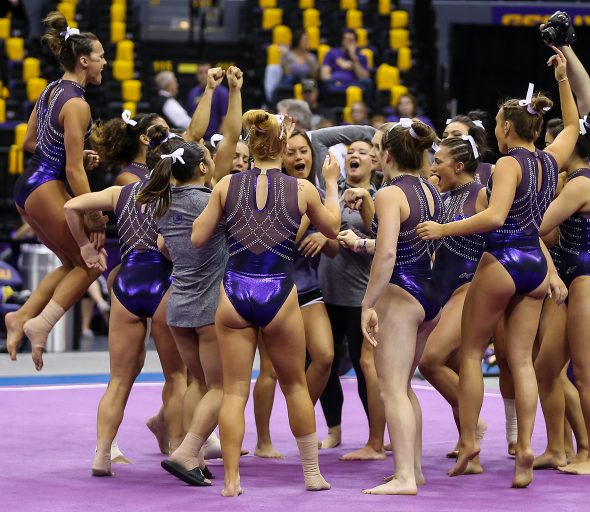
Oregon State University upsets Utah
An electrifying performance by Kaytianna McMillan on the final floor routine gave No. 11 Oregon State a thrilling 196.550-196.525 victory over No. 4 Utah on Saturday in a Pac-12 Conference duel at Gill Coliseum. …
It also served as a perfect present for OSU associate head coach Michael Chaplin, who turned 50 years old on Saturday. …
BEAVERS TAKE DOWN NO. 4 UTAH IN DRAMATIC FASHION
Madison Kocian’s 1st 10.0 Bars
I wouldn’t have gone 10 on this.
Click PLAY or watch it on Twitter.
Peng’s first 10.0 Bars
Click PLAY or watch it on Twitter.
UCLA killed Bars today with 49.725. The third-highest in school history and the highest in 12 years.
why so many NCAA Achilles tears?
REPOST with comments from Dr. Bill Sands included.
… Utah’s gymnastics team was dealt its second major blow of the season when freshman Kim Tessen tore her Achilles last Saturday. Tessen had strung together a solid debut season and was coming off her best meet of the year before the injury.
Tessen’s season-ending injury follows up Sabrina Schwab’s season-ending ACL tear. …
Tessen is the fifth Red Rock to tear her Achilles in as many years. But Utah isn’t unique, as several other teams have watched athletes succumb to the same injury this season and over the years.
“I think last year we (NCAA teams) had 16 Achilles tears reported, and this year we are already at eight or nine,” said Farden. …
Utah gymnastics still focused despite second season-ending injury
Leave a comment if you have ANY idea how we might reduce the number of Achilles ruptures.
Read a thread on the topic on College Gymnastics Board.
William A Sands, PhD, FACSM:
The Achilles tendon injuries, particularly ruptures are complex. Having studied this problem for over 20 years, I believe there is a small constellation of causative factors working separately and together. However, prediction and prevention remain elusive. I have several presentations with high-speed video of athlete and spring floor interactions, but the files are quite large. I’ve presented at the USAG Congress on this very topic more than once. Seems like it always falls on deaf ears. Well, one more try…
James Linderholm alerted me to a recent discussion on Achilles tendon injuries. I saw a list of these injuries on Rick McCharles site. Below are some references to which you might want to refer when describing and discussing what is known about these injuries and some potential causative factors.
In my view, there are several potential causes, almost impossible to tease apart.
1. The wear-and-tear of long years of training is certainly a factor. Countermeasures for this include the use of ultrasound to examine the tendon and other local structures.
2. We can probably infer from a number of studies that injury incidence and rate are linked to body composition and anthropometry (ie weight and size). Countermeasures for this can include technique alterations, nutritional interventions, and reduction of training load.
3. Floroquinolones are known to cause problems with connective tissue strength and load characteristics. I will assume that most, if not all, sports medicine professionals are aware of this problem and no longer use these types of antibiotics. However, it may be worth a check to ascertain the role(s) of these medications, history of use, and so forth. The evidence, in my view, is pretty clear. Unfortunately, long-term use has not been investigated sufficiently for determination of whether historical use may cause problems. I’m not a physician, so please check with your team doctors.
4. Technique may be involved in that anecdotal discussions have indicated that athletes with low take-off impact angles may be more vulnerable. Most, but not all, Achilles tendon injuries occur during take-offs when ground reaction forces can exceed 15-22 times body weight. Work by Bruggemann and colleagues has shown that the bundles of the tendon are load differentially depending on placement of the feet, ankle and foot anatomy, and other factors.
5. The spring floor may contribute. I have made efforts for more than 20-years to study the spring floor and its relation to take-off injuries. AAI and Whitey Anson have been very generous in helping me work on this problem. There are some interesting aspects that are addressed in citations below, and on my website: http://www.advancedstudyofgymnastics.com. Interestingly, Achilles tendon injuries have occurred on coil spring floors and foam-type floors. I believe that the natural frequency responses (rates of vibration from depression to rebound) are not consistent between the gymnast’s lower extremities and the spring floor. Unfortunately, equipment companies must follow FIG specifications and I believe these specifications, while ensuring some uniformity in design, do not take enough account of biological factors. It is also interesting to note that when T&T coaches are queried about Achilles tendon injuries – these injuries are practically unheard of. Note that the tumbling apparatuses are very different from the artistic gymnastics spring floors. On querying T&T coaches I found that only one Achilles tendon rupture was recalled, and this athlete was a former artistic gymnast and approximately 35-years old. High-speed videography of T&T tumbling surfaces has shown that the lower extremity mechanics are quite different from those used on artistic gymnastics spring floors. T&T tumbling strips are simply more forgiving than artistic gymnastics spring floors.
6. EVERYONE wants to reduce or eliminate these injuries. I hope the information below will enhance discussions that lead to countermeasures that work.
Myia Hambrick – Vault
Lizzy Leduc – Beam
should Men’s NCAA return to the perfect 10?
Mark Williams (Oklahoma): “No! I believe we must stay with the FIG scoring system to stay relevant.”
Thom Glielmi (Stanford): “Yes, but it would have to be initiated by FIG.”
Rustam Sharipov (Ohio State): “No. The majority of our guys want to make the national team, they want to go to the world championships, they want to represent the U.S. ….”
Justin Spring (Illinois): “No. The only reason the 10.0 worked, in my opinion, was because it was a score cap. Almost everyone in the competitive field had a 10.0 start value and the audience assumed that to be true for all competitors. If we go to a modified 10.0 using a scaled open-ended Code where only 5% of the competitive field is even close to a 10.0 start value, it will only confuse fans even more.”
Randy Jepson (Penn State): “Yes!!! It would be very easy to have judges determine a final score using the current FIG standards and use a multiplier on that score, which would equate to a 10. It would be a huge benefit for media and fans.”
Mike Burns (Minnesota): “As much as going back to a 10.0 might make our scoring easier to understand, I don’t feel that deviating from the FIG Code of Points is a wise decision. Because a large chunk of the Olympic developmental pipeline runs directly through the NCAA men’s program, I feel it’s imperative we stay aligned with the FIG.”
Read Logan Bradley’s response to that article – The Popularity Issue in NCAA Men’s Gymnastics

 Gymnastics Coaching.com