I’m be OK with additional awards for Elegance. Or E-score. But rewarding difficulty for the sake of difficulty could be dangerous.
“The gymnast must never attempt to increase the difficulty or the “D” score at the expense of aesthetic and technical execution. …”
China 🇨🇳 and the USA 🇺🇸 were winners of the first Fujitsu Infinity Award – presented to the teams judged to have performed the highest difficulty skills at these World Championships.#Stuttgart2019pic.twitter.com/JYklwFJcry
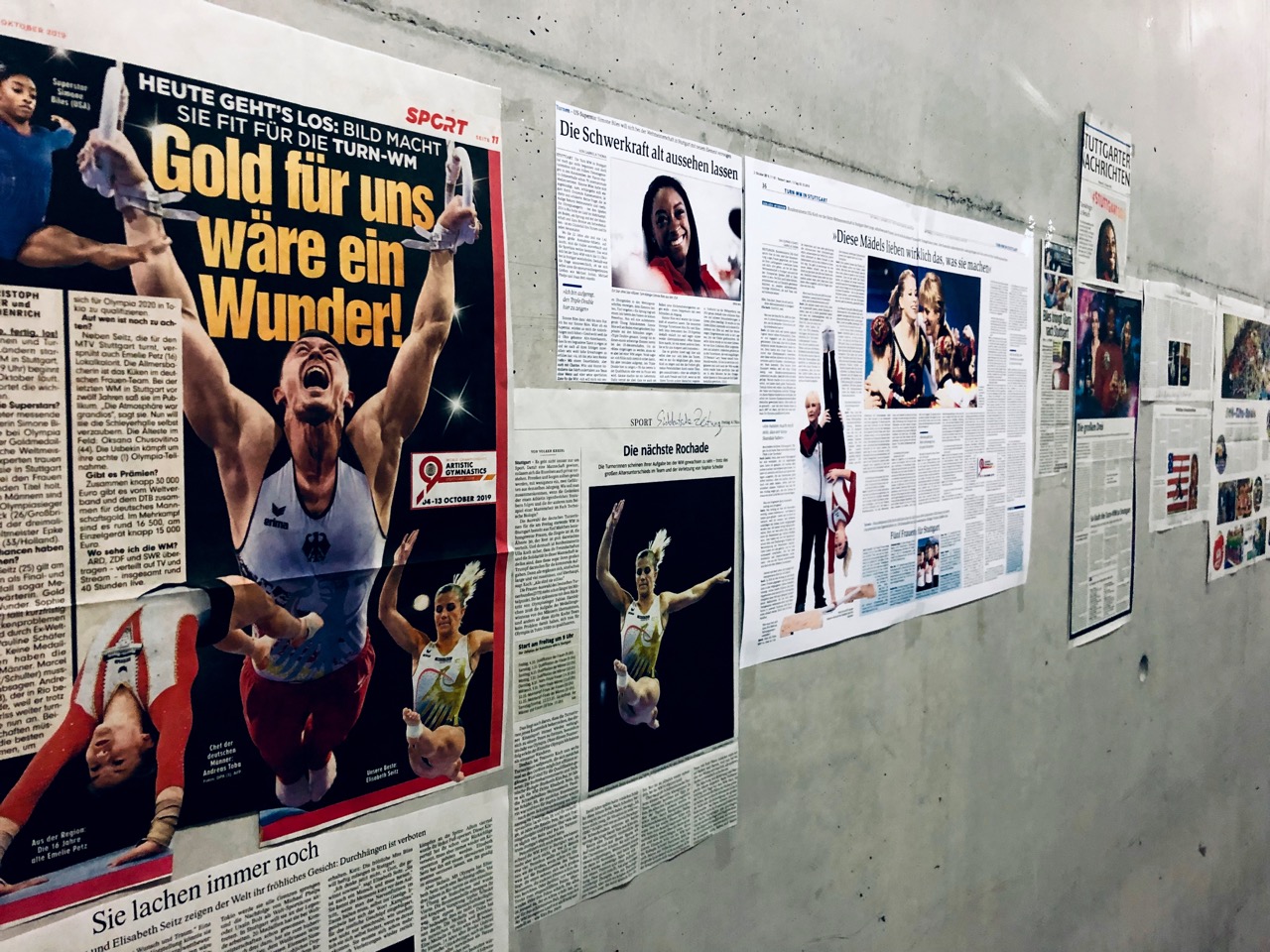
Germany always has a big media presence at Worlds.
For Stuttgart, it’s bigger than ever.
Happily, both Men’s and Women’s teams qualified for the Olympics.
Past stars including Philipp Boy and Fabian Hambüchen are everywhere. Gymnasts are pleased to be in an arena with a loud audience and so much Press. The Men’s team from Chinese Taipei looked a little bewildered to be answering so many questions.
I’d predicted RUS, CHN, USA and would probably do the same again if the teams were competing tomorrow.
I had doubts whether the young and inexperienced Japanese team would hold it together. Their routines are SO difficult. Also, Wataru Tanigawa looked to be injured in the qualification competition. But — happily — looked 100% tonight!
I was wrong. It was a superb 3 way fight for the medals. The best team competition I can recall. Ever.
I’ll be commenting LIVE via Twitter @GymCoaching. And partnering this year with @kensleyanne Kensley Behel. We both will be guest MAG pundits on the GymCastic podcasts this week.
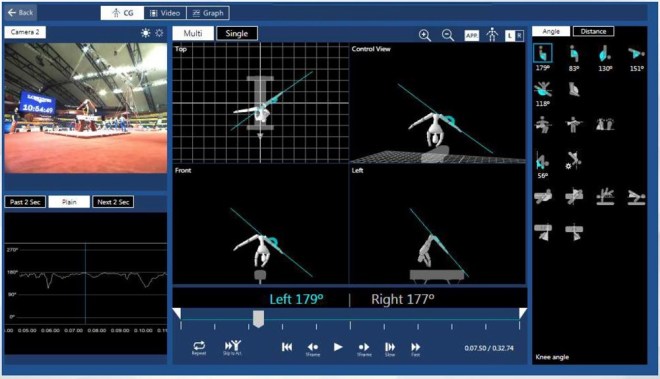
It’s being used at Worlds 2019, but only in case of appeal or ‘blocked score’. Blocked score is when the Superior Jury disagree with the D-panel start score.
MAG Vault, Rings, Pommels and WAG Vault.
WAG Beam looks near ready but is not being used here.
Steve said it had been used on Rings already and that judges had found it valuable.
IOC has not approved it for use at the Tokyo Olympics but FIG and Fujitsu plan to roll it out increasingly through to the 2024 Olympics.
I’m most excited about it being used by coaches in the Gym. Fujitsu will offer it to National Training Centres (or equivalent) worldwide.
1. United States 172.330
2. Russia 166.529
3. Italy 164.796
4. China 164.230
5. France 163.628
6. Great Britain 161.495
7. Canada 160.563
8. Netherlands 159.427
Following the IOC’s relaxation of the restrictions placed on Olympic participants during the Olympic Games period pursuant to Bylaw 40.3 of the Olympic Charter (colloquially known as “Rule 40”) earlier this year, the US Olympic and Paralympic Committee (“USOPC”) finally released its guidance on how Olympic athletes’ personal sponsors that are not IOC or Team USA sponsors may run marketing campaigns incorporating athletes during the Tokyo 2020 Olympic Games blackout period (which is July 14, 2020 through August 11, 2020) – and now permits personal sponsor advertising during the blackout period under certain circumstances and only for two particular types of marketing.

 Gymnastics Coaching.com