Canadian Comp 4 coach education

The two year National Coaching Certification Program Level 4 has been renamed. It’s now NCCP Competition 4.

The first course begins May 28, 2017 in Montreal, QC (following Canadian Championships for Artistic Gymnastics). Suzanne Fisher is coordinator.

Application PLUS a $75 non-refundable fee was due to GCG by September 15, 2016.

The coaches selected will be announced mid-October:

• 8 Women’s Artistic Gymnastics coaches
• 6 Men’s Artistic Gymnastics coaches
• 6 Trampoline Gymnastics coaches
• 4 Rhythmic Gymnastics coaches

I renewed my Gymneo.tv membership

Cost is 199 EUR ($223) / year. There are discounts if you subscribe for multiple years. And a loyalty price for current members. This year I paid 149,00 EUR ($168).

It’s a good investment for any WAG coach. The best coaching video tutorials in the world today, I’d say.

Click PLAY or watch a skill preview on YouTube.

You get access to all French and English language tutorials.

gymneo

en.gymneo.tv

Alberta Gymnastics Congress

OCT 13-16, 2016, Calgary

Hideo Mizoguchi, Frank Sahlein, David Kenwright, Alex Bard, Linda Thorberg, Kate Richardson, Chris Shaw and many more.

details

2016-fc-2_frontpage_banner

Nick Ruddock in Australia

A series of coaching events Down Under went well.

Gymnastics Ontario Congress 2016

August 26-27

Topics ranged from up to date drills and progressions, to athlete, coach, (and parent!) psychology, to enhancing your pre-school and rec programs and so much more. …

The evolution of our sport is constant… A good coach never stops learning!

Click PLAY or watch some highlights on YouTube.

Gymnastics Ontario Congress a success

All good. That’s the conclusion I heard from all the clinicians, coaches and organizers I spoke with.

Click PLAY or catch a glimpse on Facebook.

Sunday, however, will be another busy day in Milton, Ontario. A training camp is scheduled with some Congress clinicians instruction. Simultaneously the annual Ontario Coach Education meetings are on at the same venue.

how people learn

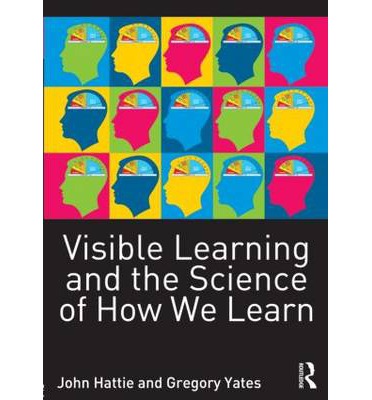
Some notes I took from a publication called Visible Learning and the Science of How We Learn by John Hattie and Gregory C. R. Yates.
Hattie

• “Unless the material is strongly meaningful, relevant and timely, it is subject to rapid and substantial forgetting.”

• “Distributed practice is more effective than massed practice or cramming.”

• “It is far easier to build on coherently organised existing knowledge than it is to learn new material … When your prior knowledge is based upon misconception, however, it will create an obstacle, an effect called interference.”

• “Strong learning occurs when words and images are combined.”

• “When the mind actively does something with the stimulus, it becomes memorable.”

• “beginners benefit from clear step-by-step instructions and an absence of problem-solving tasks. On the other hand, highly knowledge- able learners may benefit from working on problems to solve and are held back by step-by-step instructions.”

I was most surprised to read this:

• “the VAK model. This model says that human beings, as individuals, naturally fit into one of three categories, associated with the input sensory systems that we use to process information: visual learners (V), auditory learners (A), and kinaesthetic learners (K) (or VAK, for short). It is said that most of us are visual learners and will benefit from instruction which features visual elements, imagery, or spatial relationships, at least when shown in visual form. Auditory learners benefit from hearing words and learn effectively through language and building vocabulary. Kinaesthetic learners learn from movement, from action, from doing things with their hands, and tactile resources in general. …

… we reach a clear conclusion: that there is not any recognised evidence suggesting that knowing or diagnosing learning styles will help you to teach your students any better than not knowing their learning style.”

You can read that article here. Consider how those findings affect your coaching, teaching and planning.

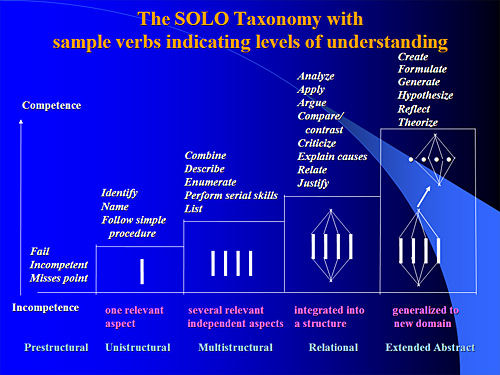
SOLO taxonomy

Have you heard of the SOLO taxonomy?

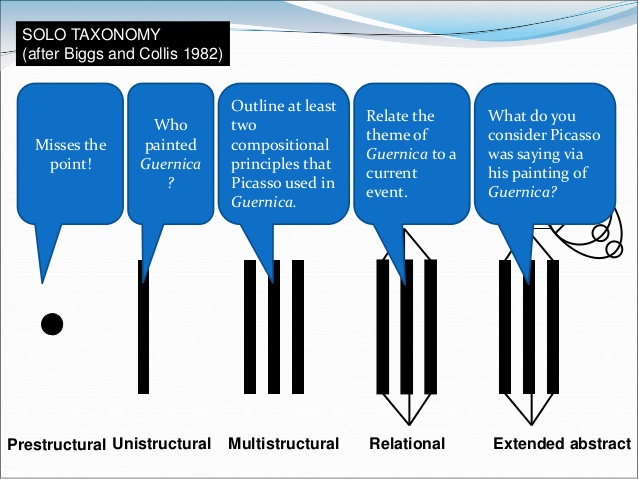
… the Structure of the Observed Learning Outcome, is a means of classifying learning outcomes in terms of their complexity, enabling us to assess students’ work in terms of its quality …

Examples:

solo_taxonomy

using-structured-solo-taxonomy-worksheets-on-teacher-education-courses-4-638

The End Of Bloom’s Taxonomy

Bloom’s Taxonomy

Have you heard of Bloom’s taxonomy?

Here’s one version of the cognitive domain (knowledge) component.

blooms

Unsurprisingly, educators debate how accurately these steps actually model the ways we learn.

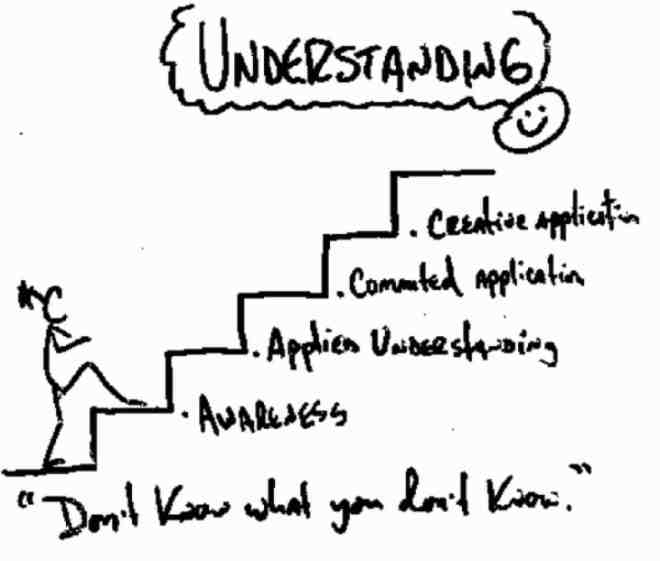
Here’s a much simplified variation I’ve often used. 🙂

stairs to understandin