
In Canadian coach education, for gymnasts, we’ve used …
Density is the Number of elements (skills)
divided by Number of attempts
Density goes up over the season. In the preparation phase an athlete might do 60 elements in 60 approaches to the apparatus.
Mid-season you might do 60 elements in only 15 turns. Warm-up then 8 half routines, for example.
During the highest density part of the season on a hard day we’ll do many full routines in the same period of time. But with longer rests between routines. Perhaps 60 elements in 8 touches of the apparatus.
During the taper before competition density drops rapidly along with volume and intensity. A low density workout might be hit 2 routines. Long rest between.
Note: this example ignores difficulty and complexity of the 60 elements.
___
Here’s another example from (easier to monitor) strength training – doing the same amount of work in less time.
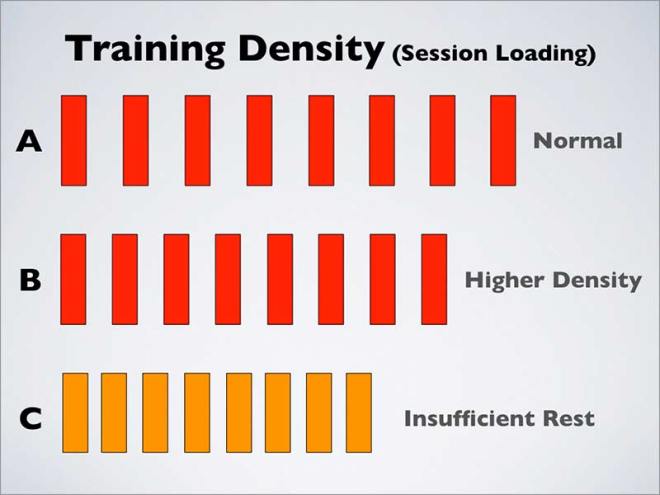
The goal would be to see a greater training effect by eliciting stronger signaling to the body.
Of course if you decrease the rest-to-work ratio between sets too much you risk poor technique and/or injury.
Therefore you’d need to experiment with decreasing rest periods gradually over time. More fit athletes will be better able to handle it sooner.
Increasing density would only be done at certain times of the year, certain apparatus and on hard days.
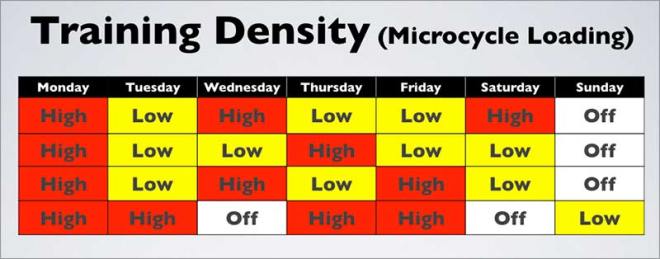
Of all the classic periodization variables and principles of training, the density of training is the least clear in the scientific literature …
Decreasing time while doing the same volume is a common approach to manipulating density, but during taper periods or recovery phases sometimes coaches do the opposite and pace slower. …
A healthy perspective is to save training density programming until everything is in place and the athlete needs to advance …
Note that many coaches don’t use density as one of their variables in planning. For most of my career I’ve found volume and intensity to be enough.

 Gymnastics Coaching.com
Rick, would you please define “intensity” in the context of the post?
LikeLike
ntensity is the Volume of work divided by Time to complete it…
• same work – but in less time
or
• more work – in the same time
Density is the Number of elements (skills)
divided by Number of attempts
So … how do you respond when asked to explain the difference?
5 routines in 25 minutes might be dense, but not intense. Gymnasts can recover between routines
LikeLike