… The Doha Cup, as one of the ‘B’ Series Cups is an apparatus cup. Gymnasts can compete in all events if they choose, but there is no all around. 165 gymnasts from 24 countries will compete. …
… One pleasant surprise in the WAG line-up is Brazil’s indomitable Daniele Hypolito. As Gymblog Brasil pointed out in a recent interview with this veteran Brazilian star, it is ten years since Hypolito won a silver medal in the floor finals at the Ghent World Championships …
Part 2 in a brilliant series of posts summing up what Stanford alumni Jason Shen learned in a long gymnastics career.
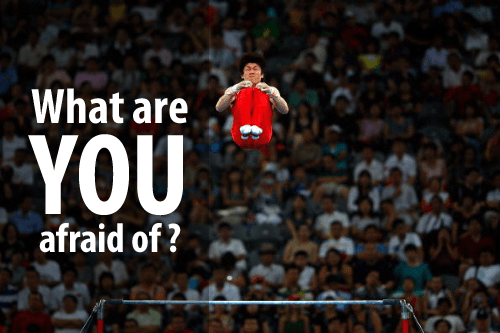
… In gymnastics, you have to force yourself to confront your fears head on, everyday, in practice AND in competitions.
One of the most important characteristics of a great gymnast is the ability to overcome fear and do what needs to be done. The stakes are higher: if you mess up a layup or a serve, not much is going to happen If you mess up on a Kovacs (the skill pictured above …) you could hit your face or slam your chest into a metal bar. And trust me, that does not feel good. …
Jason posted advice under these headings:
• Reduce Risk
• Increase Your Capacity
• Man Up and Just Do It
A Canadian coach was frustrated at the last meet after her kids had done a good job of STICKING landings:
…
Interestingly enough, we found that in order not to take a step, it was often necessary to lower ourselves down in order to gain more stability. The result however, was not a higher score – in fact, in some cases, the score went DOWN. Why?
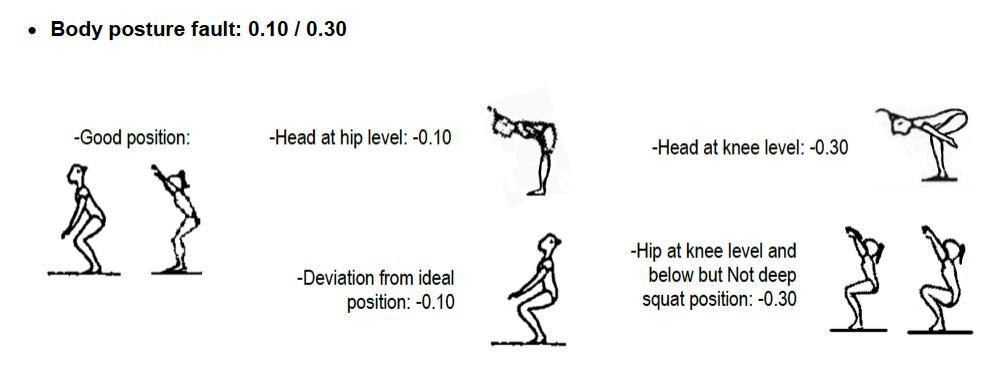
After inquiring about the E-Score (which we can do in Canada), we learned that judges were taking the 0.3 body posture deduction, even though we had ‘stuck’ our landings. …
click for larger version
I’ve seen College gymnasts stick vault, and yet get a low score for the same reason. Yet as a coach I saw no fault biomechanical nor technical in how the force was absorbed.
The score was unjust.
… But there might be an upside to this mistake in the women’s judging rules. (Men’s judges are far more reasonable.)
Keith Russell has many times speculated on what would happen if we allowed one step or hop on landing … WITHOUT deduction. He feels the number and severity of injuries would decrease.
That step / hop is tremendously effective in attenuating the force of landing. It’s much safer.
My advice for that coach, therefore, is to train the kids to do a small hop (not step) with the required posture. Also, to have them train landings up on to high mats … so that the timing of the rotation will allow a ‘kick out’ and, thus, a more vertical position with the torso.
… If the girls happen to stick with vertical posture, consider that a bonus.
Budapest (1934) was the first women’s World Championships.
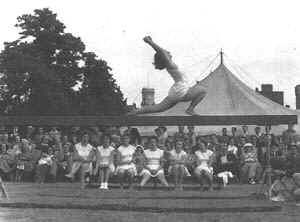
There the beam – which was still known as “Schwebekante” – was only 8 cm wide, so that it was a remarkable feat of Hungarian Gabi Muzaros who mastered a split on this narrow edge. The Italian 14-year-old Elda Lividino stood far out of the competition field with her 9,55 points …
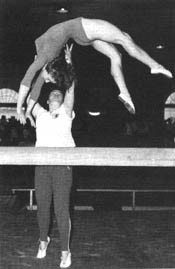
… acrobatic elements on beam started with the courageous deed of Leibzig’s Erika Zuchold and her coach Ellen Berger at the latest: Zuchold being the first woman in the world to perform a back flip on beam (1964). …

 Gymnastics Coaching.com