A favourite of Brett MacAulay’s.
Click PLAY or watch the Nike TV commercial on YouTube.
UW-Whitewater Wheelchair Basketball Player Matt Scott is one of the top players in his game. Watch an interview. His Mom accepted no excuses.
tumbling, tramp, diving, acrobatics, circus, cheer, dance, martial arts, X sports … and more
A favourite of Brett MacAulay’s.
Click PLAY or watch the Nike TV commercial on YouTube.
UW-Whitewater Wheelchair Basketball Player Matt Scott is one of the top players in his game. Watch an interview. His Mom accepted no excuses.
This could have been 40yrs ago.

I waxed nostalgic. … Memories of digging up clams, splashing the girls, trying to drown the boys in the shallows. Family holidays at wonderful Rathtrevor Beach on Vancouver Island.
But that photo was taken last weekend.

Kids are the same. But one thing has changed.

A swimming pool with that many children would have only one lifeguard.
What year was it that parents became so much more protective?
Coaches today need skills. Parent management skills.
Shane Womack, Director of Marketing for Inside Cheerleading magazine, responded to the msnbc article by Melissa Dahl, Health writer, titled:
Flying without a net: Cheer injuries on rise
Activity more dangerous than any other sport for young girls
Shane Womack:
I have to strongly disagree with this article. Unfortunately she has gotten some wrong information…
Therefore, here are some of the points that didn’t make it into the article.
The role of cheerleading:
The first is the issue of the role of cheerleaders and stunting. Most school cheer coaches recognize that their primary role is to lead the crowd at athletic contests. They can better fulfill this by doing basic “game stunts” like the thigh stands, elevators, extensions and yes – even some basket tosses. The game is going on behind the cheerleaders and the crowd is seated in high-rise bleachers. Stunts get the attention of the crowd, so that you can draw their focus to the cheer team in order to better lead them. Signs are more effective when they can be seen and partner stunts can accomplish this. In addition, the skills the cheerleaders do can build a rapport with the crowd and help them be a conduit between the crowd in the stands and the athletes on the field. As we teach, it is important to recognize that there are times for “game stunts” and that the more intricate type of skills that help attract great athletes are better reserved for entertainment-style routines at halftime or for competition.
Risk Assessment:
While there are difficulties in doing some risk assessments due to participation figures, there are in fact places where we can do risk assessments, particularly in high school cheerleading. The data from the National Center for Catastrophic Sports Injuries Annual Report shows that in 2007-2008 there were 3 high school catastrophic injuries and approximately 400,000 cheerleaders. That puts the risk of catastrophic injury per 100,000 participants at .75 but as the article does mention, that doesn’t account for the fact that cheerleaders participate all year. That means that the number of injuries for cheerleading took multiple seasons to accrue and to “normalize” the data to compare it to other sports you would have to half the risk level. That puts cheerleading at around .375 catastrophic injuries per 100,000. In simplest terms comparing it to other high school sports, that means there are 10 sports that have a higher risk of catastrophic injury than cheerleading – including 3 girls sports – ice hockey, gymnastics and soccer.
And this bears out our own experience. While articles are quick to point out common sports injuries like ankle sprains or the occasional knee brace, they have a hard time finding a program where they can point to a pattern of more serious injuries than other sports such as soccer, baseball, track, etc.
Decrease in Injuries:
Perhaps the most unfortunate part of the entire article however is that it ended with the idea that recent improvements in cheer injury statistics are due to coaches somehow “hiding” injuries. This improvement can more likely be attributed to a concrete set of circumstances than to an unsubstantiated comment.
In 2006, the NCAA working with AACCA required that all of their college cheer programs would have to be supervised by a safety certified coach in order to retain their catastrophic insurance coverage. In addition, the AACCA required that our safety rules had to be followed by these programs or their certification could be revoked. It is important to note that prior to this requirement, cheerleading made up 25% of their catastrophic claims. Since this requirement, there have been no cheerleading catastrophic injury claims with the NCAA.
Since 2004, 12 state high school associations have required their cheerleading coaches to complete the AACCA Safety Course.
In 2006, the AACCA removed basket tosses from the basketball court surface for colleges and high schools and further restricted colleges from performing 2 1/2 high pyramids on the basketball court. Further rules restrictions regarding surfaces have been implemented by both the AACCA and the National Federation of High Schools since then.
In 2004, the United States All Star Federation (USASF) was formed to provide a framework to support non-school cheerleading known as “All-Star”. They have a skill-based leveling system for rules and a credentialing program for coaches and gyms.
These efforts on the part of the NCAA, the National Federation of High Schools, the US All Star Federation and the AACCA are much more likely the reason for increased safety than the idea that cheer coaches have started hiding injuries, and it is unfair to all of the great coaches that work tirelessly to provide a safe environment for their teams.
We do commend the Journal for pointing out that the risk of cheerleading is actually closer to that of soccer than of football which has the vast majority of high school and college catastrophic injuries. However, when the true successes that have been achieved aren’t reported, it is hard to continue those successes and help them spread to other states and organizations.
Why this information was left off I can only speculate. My conversations with the reporter where very good and her questions showed a genuine interest in digging down to the real facts. There were quite a few cheer issues addressed in a short space and the article included some cheerleading history as well. Perhaps there just wasn’t room to get it all in, and unfortunately this was the part that was not included. There are many factors that go into what makes it into an article.
Regardless of the reasons, these are important safety improvements and we hope the record can be corrected.

What do you think? Are you going to be the one to go tell this athlete her sport is too dangerous?
Leave a comment.
It’s easy to criticize the parents for letting their “child” do something so dangerous:
A 13-Year-Old Kid Has Summited Everest
But this kid is no rookie. He’s already completed 6 of the 7 summits. In December he’s scheduled to attempt Vinson Massif in Antarctica.

There’s some age that’s “too young” for high altitude mountaineering. But I’m not sure what age that would be. It depends on the child, I’m thinking.
I fear some sort of age competition like the one to be the youngest to sail solo, unassisted around the world.
Perhaps F.I.G. could legislate the age.
… just kidding.
Don Eckert on the saltocafe YouTube channel:
First of all let me say that I think WOGA is the best team in America and this gymnast was great to watch. I have been coaching in region 3 for a little over a year now and they are amazing at every level.
The one strange flaw I think is this tap on giants. I see no advantages from this tap and only problems. Watching them compete at meets has made this more clear to me. My example would be their average dismounts/release moves and the many times I have seen missed blind changes in competitions. They have great strength and super lines but I would love to hear why this tap?
Click through to the YouTube page to comment.
Here’s what I posted there:
I almost never like the “tap over the low” bar. A smaller “beat action” is preferable aesthetically even if it results in slightly less power.
In the USA you can widen the bars. Does this gymnast have them at the maximum width?
Follow on Facebook. Or on twitter (CdnGymChamps). … If you post to twitter about Championships, add the hash tag #CdnGymChamps.
Gymnastics Examiner
Stu Cram – Gym Score Depot (links)
official meet home page
Web Broadcast: Saturday, May 28 Pacific Time Zone 2:30 – 6:00 pm: WAG, MAG and TG senior Finals – Barabus.TRU.ca/gymnastics (Link not live except during broadcasts.)
 I’m assisting with the “open” Cirque audition Sunday morning. Anyone can attend. Simply meet us at the competition training gym at 9AM sharp. Athletes under age-18 need be accompanied by parents or have permission.
It’s “open” so that athletes can learn about the opportunity. Attend even if you want to know more. There’s no commitment. Best practice is to attend audition at least a year before you might want to join the company.
Full NBC TV coverage is online. How about that?
Click PLAY or watch part 1 on YouTube.
Follow the links to part 2, part 3, etc.
Update: Here’s another version on YouTube, higher resolution.
(via AGB)
UPDATE: Andrew’ Thornton’s comments on the TV coverage.
Weiber’s twisting is so “clean”. WOW. And better even than Raisman.
by site editor Rick McCharles
I’ll be attending part of our annual week long (May 30 – June 5th) coaching clinic following Canadian National Championships in Kamloops.
Presenters include Canadian National Coaches Vladimir Lashin (WAG) and Edouard Iarov (MAG). And MAG Youth National Coach, Markos Baikas.
As always, the course will be coordinated by Keith Russell, current President of the FIG Scientific Commission.
 Welcome to our special guest, planning guru, Dr. Istvan Balyi.
You don’t hear much about planning these days. It’s fallen out of favour, me thinks. Istvan can light the fire, once more.
Any ideas of genius coming out of the course, I’ll post here.
I’ll be doing a short presentation to the group myself, “The Internet for Elite Coaches”.
Dr. Gerald S. George is out and about, doing seminars in support of his new book Championship Gymnastics.

International Gymnastics Camp
Coaches Education Program
Bartonsville, PA
June 21-23, 2010U.S.A.I.G.C. Congress
Coaches Education Program
Ft. Lauderdale, FL
June 27-29, 2010USAG National Congress and Trade Show
Four (4) Lecture Presentations
Hartford, CT
August 12-14, 2010Winning Gymnastics – Seminars
The former Utah star jumped into a new sport. Apparently Elite Gymnastics and the NCAA weren’t enough to convince her to retire.
Only to hang up her grips.
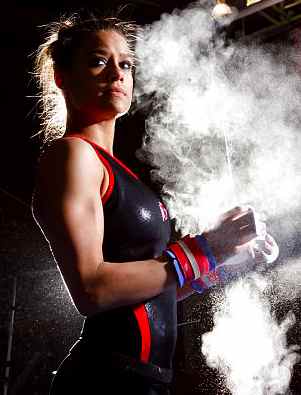
… Postell dabbled with both trampoline and power tumbling – sports which involve many of the same skills as gymnastics but require less of a time commitment. Power tumbling came more naturally, so Postell shelved the trampoline challenge for a later date. …
Her goal is to qualify to VISA Championships for the first time, … first time as a tumbler, that is.
Almost 24yrs-old, Ashley coaches at Black Diamond Gymnastics in Park City Utah.
_____
Disclosure: I’d finished writing this post before realizing that Black Diamond is a club website built by one of our advertisers, Direct Works Media. Click through their link to support Gymnastics Coaching.
 Gymnastics Coaching.com