Click PLAY or watch it on YouTube.
173,000+ views

tumbling, tramp, diving, acrobatics, circus, cheer, dance, martial arts, X sports … and more
A book review by site editor Rick McCharles
This is the best of their 4 men’s apparatus books, so far.
And definitely the best of the series for coaches of women as there’s a lot of WAG content.
Vault
Methods, Ideas, Curiosities, History (2004)
by Istvan Karacsony and Ivan Cuk
Forward by Mitsuo Tsukahara
… Tsukahara started working “his” vault on the women’s horse in 1969 as his Yamashita (the winning vault of the day) was poor.
He competed Tsuk successfully at Worlds 1970. (Andzej Szajna from Poland was first to attempt Handspring Front, at the same meet, but sat down the landing.)
There’s a chart showing who first did each vault for men and women, regardless of whether or not it’s named after them in the respective codes. That will help answer a few coach arguments.
The history of this apparatus is fascinating, the first historic images dating back to 2500 BC.
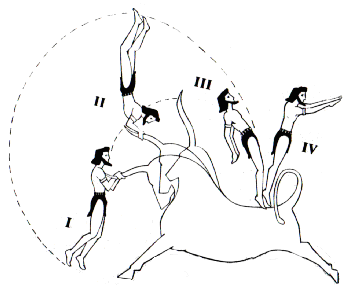
This text documents the evolution of both horse and spring board.
Interesting statistics from Worlds 2002 (20m distance run):
• most women took 13-15 steps
• most men took 13-14 steps
The main reason I like this text the best of the four in the series is the detail. Vault has much less content than the other apparatus, so (in the same 150 pages) the authors could include more biomechanics, specific conditioning, etc.
Even if you fancy yourself a vault expert, you’ll still learn a lot from this book. If you could only get your hands on it. There’s no world wide distribution, as yet. (Leave a comment if you know of someone who might want to distribute for them.)
The conclusion was no surprise:
The faster you run, the better. Male gymnasts should strive for over 10m/sec velocity. Female gymnasts over 9m/sec. peak velocity, decelerating as little as possible on board contact.
Zamo topped out at 9m/sec at the 2002 Worlds, for example. Dragalescu was well over 10m/sec.
The most argued phase is not clarified all that much … the hurdle for non-Yurchenko vaults.
Time of the hurdle is between .24 and .30 seconds. Maximum height of the feet was 35cm. But the conclusion I wanted (the shorter the time for any given velocity, the better) is not there.
There is an interesting finding that I’d not seen anywhere else. The top Yurchenko vaulters (i.e Scherbo) have a longer round-off. (i.e. 322cm from the take-off foot to the landing on the Board)
Obviously you need to run fast to do that.
OK.
There are a hundred other interesting points in this manual.
• Defer’s morphological statistics one month prior to winning the 2000 Olympics
• statistics on Dragalescu’s vault
• technique on selected vaults
• conditioning drills
There’s a long section written by Matej Tusak on the psychology of vault, including preventing burnout. Strategies for success.
…Back in the 1990s we several times sent boys to train with Karacsony in Hungary. And several times had him come to Canada as a guest coach. I see many of his favourite vault drills in this manual.
Istvan Karacsony is on the Men’s Technical Committee.

Ivan Cuk edits the Science of Gymnastics Journal
Wayne Goldsmith challenge:
Win, lose or draw, there are 50 Things You Must Do After a Major Competition…if you want to win the Next One (if you seriously consider yourself a high performance coach)

This truly is one of the best coaching blogs. Click through to feel wanting as a coach.
50 Things You Must Do After a Major Competition…if you want to win the Next One!
Thanks Brett.
She’s is competing at Voronin Cup right now.
Another great young talent, age-eligible to compete in London 2012, from Russia. This is Blythe’s “favorite new floor routine of the season”.
Click PLAY or watch her Floor on YouTube. (There’s a better version on Examiner.)
Anastasia won Top Gym. I saw that routine linked from this post – 10 must-see routines from Top Gym.
Check the awesome ff Arabian on Beam (VIDEO) from Sophia Serseri (FRA).
USA Gymnastics’ Talent Opportunity Program (TOPs) is in its 19th season and is still going strong. Fifty-four athletes participated in the three-day National TOPs Team Camp at the Women’s National Team Training Center, held at the Karolyi Ranch in Huntsville, Texas, Dec. 1-5.
An additional 58 athletes participated in the TOPs B Camp, Dec. 5-9. For the first time in the program’s history, 8-year-old gymnasts participated in the training camps with tremendous success.
The athletes were instructed in all four Olympic events and dance by the National Team Developmental Coaching staff. Lectures were also given by the staff to the coaches on training techniques. …
Gary Warren, the USA Gymnastics Elite Program Director who oversees the TOPs program, said, “The training camps were, without a doubt, the most productive camps in our 19 years of existence and the inclusion of the 8-year-old athletes was a tremendous success.”
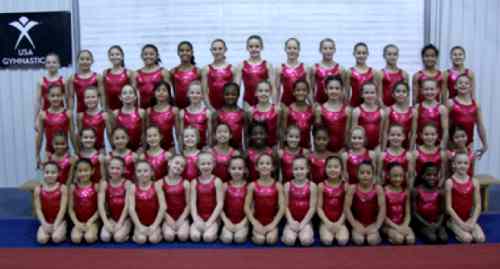
Awesome.
Barb Durfee from WOGA lets us know that dozens of the top routines from the recent Men’s 2010 Valeri Liukin Invitational are posted online. Routines in yellow are available.

Danell Leyva had a great meet, winning the all-around with an impressive 90.95.
But browsing some of the top routines, I’m finding the scores rather high. Danell got 15.80 for his winning P Bar set.
Click PLAY or watch his routine on YouTube.
Ryohei Kato went 15.70 to win Floor with this quite deductible set (VIDEO).
If you were there, leave a comment. Were scores high as it was a friendly invite?
24 teams MAG and 24 teams WAG have qualified to the next Worlds, Tokyo, Oct. 2011.
The top 8 teams in Tokyo will qualify for the Olympics.
That leaves 16 teams to fight it out for the final 4 spots at a second trial, the pre-Olympic test event in London, Jan. 10-13, 2012.
Both “trials” meets will be super compelling. … However, nations who are not confident of finishing top 8 in Tokyo must plan and budget for two major meets within 4 months.
A team happy to finish 9th to 12th (Canada, for example) might use a strategy to PEAK for the second trial. (Tokyo would be low priority, London high priority.)
Those teams that have no chance of finishing top 8 in Tokyo might even leave some of their best gymnasts home, training for London.
This same new Olympic qualification system is being used in Rhythmic and Trampoline
Anyone hearing complaints about this? … It’s going to be really expensive for those nations having to compete both trials.

You’ve probably heard about the minimalist running shoe trend.
None of those are appropriate for indoor acrobatic training.
But what about this concept – called footstickers – from Nike?
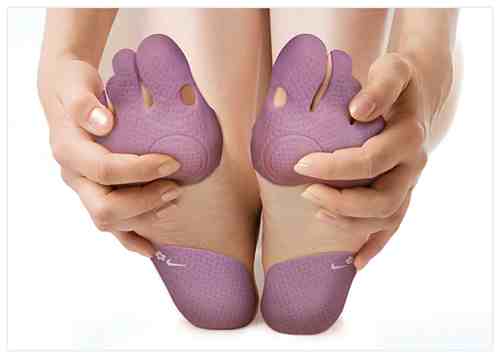

… models are shown for yoga and dance, and how they’d actually stick to your feet isn’t explained, nor is the connection to Nike. …
I’m not convinced this is the Beam footwear of the future, but it’s worth experimenting if and when they are actually manufactured. It would be a cleaner ‘look’ than homemade pads or ShockSox.
(via behance)
LSU gymnastics head coach D-D Breaux is going to live and spend the night inside a tent in the LSU SportShop beginning Thursday, and she will remain there until Dec. 21 unless she reaches her goal of selling 200 gymnastics season tickets.
Tickets are only $25 for adults and $15 for youth ages 3-12, and LSU gymnastics season tickets can be a the perfect holiday gift for the family.
… Spring is entering his fifth season overall on the coaching staff, after spending one year as an associate head coach and three years as an assistant coach under 33-year veteran Yoshi Hayasaki.
“It’s truly an honor to take over a program I grew to love so much as a student-athlete,” Spring said. “My passion for the program has only increased and I look forward to doing the best I can to make this program as successful as possible.”
… in addition to his coaching duties, is currently pursuing his master’s in recreation, sport and tourism.

 Gymnastics Coaching.com