translating web pages

I had a Spanish comment on this blog from Rafael:

deseo conocer muchos tips y consejos pero en español. please. thank very much.

Using the Babelfish webpage, it translated from Spanish to:

desire to know many tips and advice but in Spanish please. thank very much.

I recommend you use Babelfish (or one of the alternatives) for translating these posts if English is not your first language. The internet is still mainly in English though that is changing quickly.

Google already offers “translate this page” into English, a service I use all the time. It shows up on results pages when you do a search and find a non-English page.

another “no-pommel” horse

Men’s coaches would have a hundred different pommel training devices if they could.

Here’s one at Calgary Gymnastics Centre, home of Adam Wong.

no-pommel-horse.jpg

Alexandra Orlando – female athlete of the year

Alexandra Orlando is on some run!

She won all six rhythmic gymnastics events included as part of the gymnastics program at the 2006 Commonwealth Games in Melbourne tying the single games record.

And now was just named Commonwealth Games “female athlete of the year”. Wow!

That puts a gymnast ahead of every other female athlete in the second largest international games. Congratulations.

The “male athlete of the year” was Jamaican sprinter Asafa Powell, by comparison.

Alex trains at Ritmika in Toronto under Mimi Masleva.

… this stunning young woman instantly became the standard-bearer for her sport and its most recognizable star since Lori Fung of Vancouver won gold in the sport’s Olympic debut in 1984 at Los Angeles.

Alexandra went on to become our national champion for the fifth straight year and then cracked the top 15 in her sport internationally. Many say she is already number one in the world at ribbons, which is a key element of rhythmic gymnastics.

She has her eyes on an even bigger prize: the 2008 Olympics. Alex is now ranked 15th, internationally. She is now a current co author of her autobiography “Alexandra Orlando: In Pursuit of Victory” which came out on September 29th 2006.

Alexandra Orlando – Wikipedia, the free encyclopedia

Alexandra Orlando: In Pursuit Of Victory

Alexandra Orlando: In Pursuit Of Victory

3 typical mistakes on “flyaway” dismounts

flyaway.gifPeter Pidcoe wrote a biomechanical analysis of common errors on the problematic flyaway dismount.

His article is quite technical. But most coaches will agree with the list:

1) gymnast tucks too soon prior to bar release

2) gymnast hangs on too long … or “closes” shoulder angle prior to release

3) gymnast throws the head back on or before release (often releasing in the arched position, as well)

Of the three, the first two errors are far more serious to me. If a beginner hits the bar once, progress can be set back 3-months or more!

The third error reduces the chance of hitting the bar. I call those flyaways “whip backs”.

Training Uneven Parallel Bar Back Salto Dismounts – Technique

At every age group competition I attend, there are very few good flyaways. This is one of the most challenging skills kids learn.

Coaches need to start at a younger age / stage and devote more attention to flyaway dismounts.

Check my progressions to prevent these errors.

If you like this article, you may want to search for other posts with the key word “flyaway”.

introducing flyaway to beginners

– Rick McCharles, editor GymnasticsCoaching.com

Horizontal Bar and Asymmetric Bars

Shaping skills with drills:
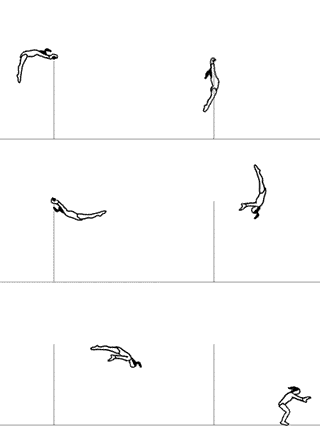
flyawayOne of the worst things that can happen to a young gymnast is to hit the bar on a flyaway dismount.

As a coach, planning to prevent this accident is my highest priority.

My favourite drills include:

  • simple release drills with beginners age 4-5
  • flyaway release to “flat back” landing age 5-6
  • spot layout forward (reverse) flyaway to flat back age 5-6
  • I recommend doing 1 year of 3/4 forward flyaway (3/4 salto forwards to flat back landing) with beginners before starting regular flyaway (salto backwards).

    Why start with forward flyaway?

    It is no more difficult than regular backward flyaway — but is much safer. Children have far less chance to hit the bar with their feet. Beginners can see where they are going, as they do on dive rolls.

    Indeed, I have had hundreds of once-a-week recreation gymnasts learn 3/4 forward flyaway in one or two trainings. And be able to show off that impressive skill to Mom & Dad into a pit, safely. (Easiest is a forward somersault from rings into the pit, if you have rings over a pit in your gym.)

    When I have a great deal of confidence in a child doing forward flyaway, I start developing the regular backward flyaway.

    Unfortunately, backward flyaway requires a great deal of safety spotting. Normally I do not have time to spot as many backward flyaway drills as I wish I could.

    flyaway.jpgTo supplement, I set up as many non-spotting stations as I can — the ultimate being the one shown in the photo sequence.

    The foam cube is a target for the feet, set lower & further than optimal to ensure the gymnast deliberately releases early.

    Kids love these drills. They are happy to practice flyaway all work-out. They build confidence.

    The set-up in the photo sequence is very steep! Recommended only for advanced, confident kids. Most beginners would have the mats closer to the bars.

    This drill is a game, not a flyaway. But it will help the kids learn to “pitch out” — displace the centre of gravity forwards at the instant of release. They need hang on only about 1/10th of one second too long to hit the bar.

    I still need to spot hundreds, or thousands of flyaways for each gymnast watching closely for the phenomenon I call “creep”.

    Many kids tend to creep closer & closer to the bar before the one turn when they hit their feet or shins. If I suspect a gymnast is creeping, they must go back to pitch-out drills.

    Ideally a gymnast learns layout flyaway first. No tucked flyaways until they start turning double somersaults.

    Why?

    Tucked flyaways have a tendency to bring the feet & centre of gravity closer to the bar, not further. Tucked flyaways are more dangerous than layout.

    The only problem teaching layout flyaway first, is that beginners often do not have enough swing to rotate to their feet.

    Solution? I do all layout flyaways as 3/4 somersaults to land on hands & knees on a soft mat. This again helps avoid the off-chance of hitting the feet on the bar.

    Ideally, a gymnast needs not land on their feet until they swing from handstand.

    The result? A high, slow rotating flyaway dismount.

    Does it sound too easy? It is. This is a short article.

    If you find a coach who has all gymnasts in a club doing reasonable flyaways, you have found a very good coach. Flyaway is one of the most technical skills we teach.

    Go slow. Be patient. Withdraw spotting reluctantly.

    At Taiso Gymnastics we required gymnasts doing flyaway dismounts without spot to do them over the pit. And had a team mate slide a soft mat along the bar just in case they were close on that one turn. This safeguard is quite common in men’s gymnastics, surprisingly rare in women’s.

    photo sequence – Funtastics Gymnastics, Idaho, USA – coach Derek Rennebaum

    This post was updated from the original on the i-NEEDtoKnow website.

    If you like this article, you may want to search for other posts with the key word “flyaway”.

    trivia – that’s Hardy Fink, past FIG Men’s Tech Chair in the background of the photo sequence
    Court: Boy Can’t Join Girls’ Gym Team

    Yet another one of these cases.

    Is it not a waste of time for the legal system?

    MADISON, WIS. — A state appeals court on Thursday rejected a lawsuit by a boy who wanted to compete on his high school’s girls’ gymnastics team.

    Newsvine – Court: Boy Can’t Join Girls’ Gym Team

    The simple solution is to disallow anyone in any sport from competing against the opposite sex, except in co-ed sport situations.

    Sorry Michelle Wie.

    Gifs.net gymnastics animations

    Coach Kyla is looking for animations. Here is another site offering a few for free.

    The one shown below was created by George Novak from Edmonton, Canada.

    gymnast.gif

    Gifs.net Free Animations – –

    By the way, handsprings done on the same spot are called … “spotters” by coaches in Cirque du Soleil. I had never heard the term applied to tumbling.

    Very cool are forward spotters: flysprings done in series on the same spot. I saw a gymnast learn them on a tumbling tramp in about 15mins. She had great flysprings, but had never tried to undercut that much. (Looked like a good drill for athletes wanting to improve their front tumbling.)

    Very few athletes can actually counter travel. That is, travel forward while doing backward handsprings. But it is possible.

    7 conditioning priorities for gymnasts

    Sands, McNeal and Jemni have offer advice for “coaches who are seeking to simplify and coordinate their conditioning programs.”

    Gymnastics conditioning can be distilled to a group of only seven fundamental movements. Coaches should be aware that gymnasts train movements – not muscles. …

    With only a few exceptions, most gymnastics movements are multi-joint, multi-planar, and multi-directional. Simple uniplanar movements rarely mimic sport movements and result in a somewhat misplaced priority for training and conditioning.

    Training for gymnastics conditioning consists of the following fundamental movements:

  • Shoulder flexion – casting, press handstands, planche
  • Shoulder extension – kipping, uprise, downswing phases of in-bar work
  • Upper extremity pushing – handstand, handstand push up, rebounding during hand contact phases
  • Upper extremity pulling – pull up, pullover, withstand the bottom of swinging skills
  • Jumping and landing – tumbling, vaulting, mounts, dismounts, dance movements
  • Torso and hip flexion – piking, tucking, leg lifts, forward somersault take offs, hollow body positions
  • Torso and hip extension – arching, back bends, walkovers, flic flacs, most backward take offs
  • smj-img1.gif

    Seven Fundamental Movements for Conditioning Gymnasts

    This is similar to what we use in Canada though the terminology differs. Canadians call this kind of conditioning taxonomy the “prevailing body actions” of gymnastics.

    Useful to set and evaluate conditioning programs. Right?

    The same authors did a follow-up article: Circuit Program Design

    smj2-img7.gif

    Shewfelt interviewed by comedian Rick Mercer

    This is one of the best and funniest sports profiles I’ve ever seen. It happened right after Kyle Shewfelt won Floor in Athens.

    Rick Mercer hosts the top rated arts and entertainment TV show in Canada — now called The Rick Mercer Report — and when you see this clip, you’ll understand why this comedian is so popular. He’s hilarious.

    If Dragalescu from Romania had won gold on Floor in Athens, he would have been awarded US$65,000 by his, one of the poorest governments in Europe.

    The payoff for a Canadian winning Olympic gold? ZERO!

    Mercer is merciless in bringing that point home. I hope the Sports Canada bureaucrats were squirming when they watched this interview.

    Click PLAY or see the video on YouTube.

    Animation Factory – “gymnast” cartoons

    Moving images on the internet can be very distracting.

    But if the movement is subtle, and the image cute enough, I still like some of them.

    4968537.gif4968537.gif4953882.gif

    Animation Factory – Royalty Free Animations, 3D Clip Art, Backgrounds, PowerPoint Templates, and Video Clips

    If you wanted to use some of these on your own website, it costs US$30 and up for membership.