Starts creepy. Gets worse.
Click PLAY or watch it on YouTube.
Name this bad film.
tumbling, tramp, diving, acrobatics, circus, cheer, dance, martial arts, X sports … and more

Skip this post if you don’t have your own blog.
Every year or so I experiment with offline blogging software, usually MarsEdit, as that seems to be the most popular on the Mac platform ($40). (The main competitor, Ecto, is only $20.)
There is a bit of a learning curve in using MarsEdit. But I think I’m willing to spend the time to learn it. Finally.
Advantages:
• it’s faster to work offline
• live preview while you edit
• you can set up a “template” to duplicate the look and feel of your actual blog
Problems:
• no option to open links in a new window
• the resulting HTML text is more complex, more difficult to go back and edit
Leave a comment if you’ve a better solution to write blog posts offline. This post was written with MarsEdit. See any problem with it?
Nathalie from Netherlands made a sweet tribute video for Ana Porgras.
Sometimes I feel like I’m alone
Sometimes I feel like I’m not that strong
Sometimes I feel so frail so small
Sometimes I feel vulnerable
Sometimes I feel a little fragile
A little fragile
Click PLAY or watch it on YouTube.
Ana is neither fragile nor vulnerable.
But she is under-hyped. Far better than many average fans give her credit.
Bea linked to that edit in celebration of Ana’s birthday, December 18th.
For those coaches who feel wrist supports are as much a fashion accessory as a training aid, … confirmation:

American Gymnast – Animal Print Tiger Paws (sale $51.95)
Be sure to watch Jay Thornton’s sizing video before you order.
Mary-anne Monckton qualified to the Australian Commonwealth Games team … then was injured tumbling into the pit. (She landed on the edge of the Floor.)
She was replaced by her closest friend on National Team, Georgia Wheeler. And had ankle surgery the day after the girls left for Delhi, a reconstruction.
Today Mary-anne is back training, working towards Worlds 2011. Her story is documented on Couch Gymnast.
For inspiration, Mary-anne should read the story of Raj Bhavsar. He was named a non-competing Olympic alternate, … twice.
 That after filling 100 pages of a notebook with this line:
I am on the 2008 Olympic team. I am on the 2008 Olympic team. I am on the 2008 Olympic team.
But today Raj has an Olympic Bronze medal. He persevered and achieved his goal. HIs advice to Mary-anne …
“Never give up.”
Read his story in the Houston Chronicle – His future is up in the air
(via Full Twist)
Who can “hang” the longest?
Click PLAY or watch it on YouTube. (6min)
That was aired on Man vs. Beast.
A book review by site editor Rick McCharles
This is the best of their 4 men’s apparatus books, so far.
And definitely the best of the series for coaches of women as there’s a lot of WAG content.
Vault
Methods, Ideas, Curiosities, History (2004)
by Istvan Karacsony and Ivan Cuk
Forward by Mitsuo Tsukahara
… Tsukahara started working “his” vault on the women’s horse in 1969 as his Yamashita (the winning vault of the day) was poor.
He competed Tsuk successfully at Worlds 1970. (Andzej Szajna from Poland was first to attempt Handspring Front, at the same meet, but sat down the landing.)
There’s a chart showing who first did each vault for men and women, regardless of whether or not it’s named after them in the respective codes. That will help answer a few coach arguments.
The history of this apparatus is fascinating, the first historic images dating back to 2500 BC.
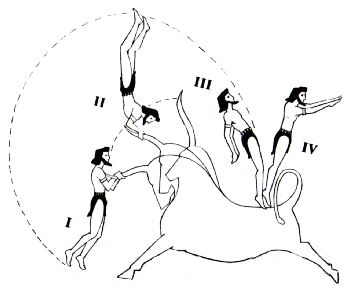
This text documents the evolution of both horse and spring board.
Interesting statistics from Worlds 2002 (20m distance run):
• most women took 13-15 steps
• most men took 13-14 steps
The main reason I like this text the best of the four in the series is the detail. Vault has much less content than the other apparatus, so (in the same 150 pages) the authors could include more biomechanics, specific conditioning, etc.
Even if you fancy yourself a vault expert, you’ll still learn a lot from this book. If you could only get your hands on it. There’s no world wide distribution, as yet. (Leave a comment if you know of someone who might want to distribute for them.)
The conclusion was no surprise:
The faster you run, the better. Male gymnasts should strive for over 10m/sec velocity. Female gymnasts over 9m/sec. peak velocity, decelerating as little as possible on board contact.
Zamo topped out at 9m/sec at the 2002 Worlds, for example. Dragalescu was well over 10m/sec.
The most argued phase is not clarified all that much … the hurdle for non-Yurchenko vaults.
Time of the hurdle is between .24 and .30 seconds. Maximum height of the feet was 35cm. But the conclusion I wanted (the shorter the time for any given velocity, the better) is not there.
There is an interesting finding that I’d not seen anywhere else. The top Yurchenko vaulters (i.e Scherbo) have a longer round-off. (i.e. 322cm from the take-off foot to the landing on the Board)
Obviously you need to run fast to do that.
OK.
There are a hundred other interesting points in this manual.
• Defer’s morphological statistics one month prior to winning the 2000 Olympics
• statistics on Dragalescu’s vault
• technique on selected vaults
• conditioning drills
There’s a long section written by Matej Tusak on the psychology of vault, including preventing burnout. Strategies for success.
…Back in the 1990s we several times sent boys to train with Karacsony in Hungary. And several times had him come to Canada as a guest coach. I see many of his favourite vault drills in this manual.
Istvan Karacsony is on the Men’s Technical Committee.

Ivan Cuk edits the Science of Gymnastics Journal
Wayne Goldsmith challenge:
Win, lose or draw, there are 50 Things You Must Do After a Major Competition…if you want to win the Next One (if you seriously consider yourself a high performance coach)

This truly is one of the best coaching blogs. Click through to feel wanting as a coach.
50 Things You Must Do After a Major Competition…if you want to win the Next One!
Thanks Brett.
 Gymnastics Coaching.com