More than 700 of the USA’s top Level 9 and 10 gymnasts will compete in the 2010 U.S. Men’s Junior Olympic National Championships, May 6-9, at the Knoxville (Tenn.) Convention Center. The event features competition in regional team, all-around and individual apparatus. …
Hideo (Mizo) Mizoguchi’s Pommel Horse Development DVD covers two of the five areas required by the FIG for competitive pommel horse. It covers side and cross travels, and the requirements for Wendy’s, Kerr’s and Flops.
He does this by thoroughly explaining and demonstrating longitudinal travels, single pommel circle development and the Stockli “B”. Mizo includes excellent demonstrations for all the progressions of these important skills for competitive pommel horse. All the progressions are presented in a way to help with the development from the compulsory level competition to elite.
Though it’s not exactly The Honda, I’m still proud of this Canuck done good.
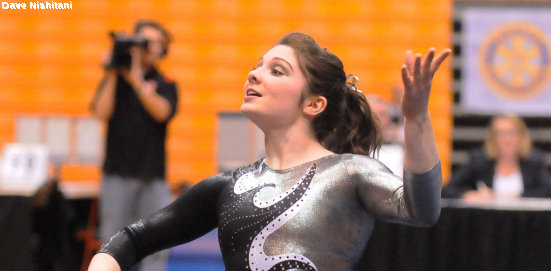
Stephanie McGregor was awarded the Joy Selig Award, an award that annually goes to the gymnast who most distinguishes herself academically and athletically and exemplifies courage and leadership, both on and off the competition floor.
McGregor, a sophomore from Calgary, Alberta, is involved in the Student-Athlete Advisory Committee (SAAC) and was chosen as one of OSU’s everyday champions in 2010. …
She “hit” 22 out of 24 routines in 2010.
… McGregor was also recognized as the team’s Outstanding Scholar. Claiming the award for the second straight year, McGregor studies Pre-Bioengineering and studies within OSU’s Honors College. Last month, she received Pac-10 All-Academic first team honors in her first year of eligibility. …
LSU senior gymnast Susan Jackson was named the recipient of the prestigious Honda Sports Award for gymnastics as the nation’s top collegiate female gymnast, American Honda Motor Co., Inc. announced Wednesday.
The honor was based on the results of national balloting among 1,000 NCAA member schools as part of the Collegiate Women Sports Awards program, now in its 34th year.
This marks the first time an LSU gymnast has received the award …
Sure genetics, physical ability, and technical / artistic preparation are important …
But, in the end, what makes or breaks a gymnast is in the psychological domain.
A “good motivator” coach is typically more successful than a “biomechanist coach”.
It’s relatively easy to coach a Yurchenko, for example, but difficult to convince a young girl that she wants to jump backwards over a big obstacle.
Mark Folger from Wichita, Kansas posted on this topic – Goal Setting and Motivation:
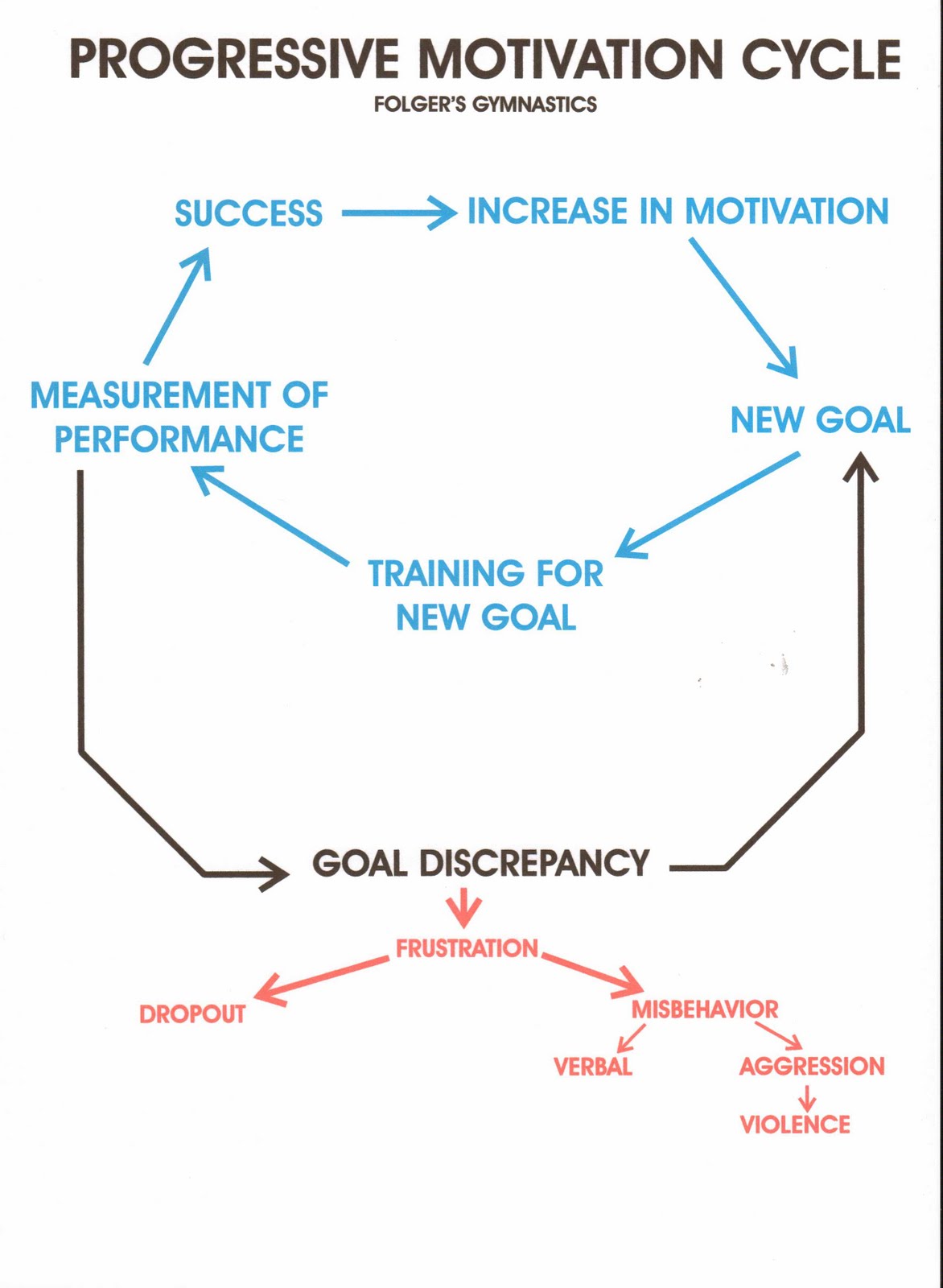
A sense of accomplishment increases motivation. Success and accomplishment are relative to past performance and current goals. Therefore, choosing appropriate goals plays a key role in consistent motivation. I use a simple flow-chart I call the Progressive Motivation Cycle to remind myself and my staff of the relationship between setting goals and motivation.
The Blue Cycle is the preffered cycle. When our athletes are rolling along in the blue cycle, life is great. …
click for larger version
The challenge for coaches is what to do when the gymnast does not achieve the goal. How best to handle the process of reevaluating and committing to new goals.
If you let a gymnast get to the red level on the chart, you might lose them from the sport.
I never miss reading Mark’s posts. Read the rest of this article – Folger’s Gymnastics – Goal Setting and Motivation






 Gymnastics Coaching.com