Watanabe – advanced bwd handspring

Naama Arad, like me, was challenged by this Gymnastics Minute instructional by coaching legend Mas Watanabe.

Click PLAY or watch it on YouTube.

… My advice to Naama is to consider this an advanced technique. Beginners should perfect long, low backward handspring series first. (Think of a rock skipping across a lake.)

Manjak has gymnasts do many sets of 5 normal ffs every day, for example.

Much, much later you can shape the skill for specific reasons, as Watanable is doing here.

Olympic gymnast Amy Chow weds

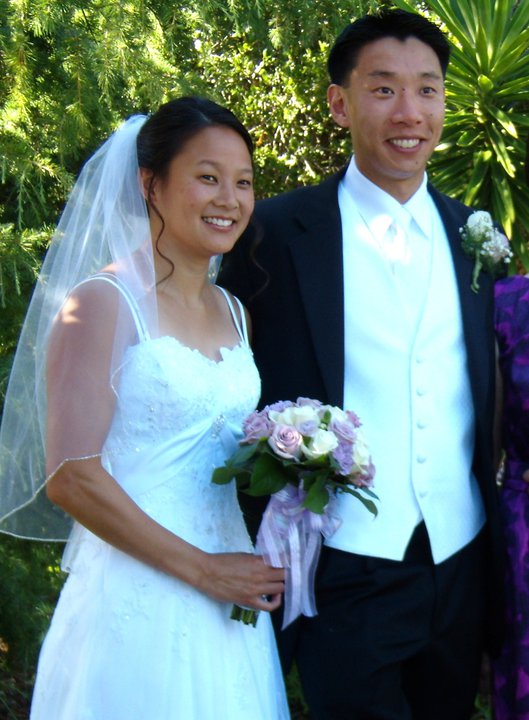
1996 Olympic gold (team) and silver (uneven bars) medalist and 2000 Olympic team bronze medalist Amy Chow was married to Jason Ho on July 10 in Saratoga, Calif.

(via USA Gymnastics on Facebook)

Katelyn Ohashi – Beam

Gymnastike chose her routine from the 2010 CoverGirl Classic Jr. competition as their Routine of the Week.

Love the artistry and the laid out full twist. Wobbly, though. (15.05)

Click PLAY or watch it on Gymnastike.

http://c1403192.cdn.cloudfiles.rackspacecloud.com/player.swf

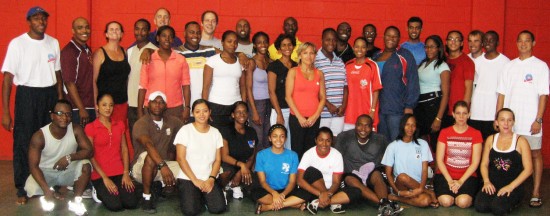
Evans, Hall, Manjak, Davydova

Hardy Fink runs the F.I.G. Academy coach education program.

How did he convince this powerhouse line-up of some of the best coaches in the world ALL to go to Trinidad for the entry level course?

The course leader was Chris Evans of Great Britain who has served as an expert for theory lectures, as course leader and as Women’s Artistic Gymnastics expert at multiple Academies. At this Academy he taught all of the theory lectures. Paul Hall also of Great Britain and coach of that country’s best male gymnasts served as expert for the men’s apparatus. Kelly Manjak, former coach of Olympic Gold medalist Kyle Shewfelt and now one of Canada’s top women’s coaches served as the expert for the women’s apparatus. A special delight was to have the services of 1980 women’s All-around Olympic Champion, Jelena Davydova (RUS) present to teach artistic preparation, choreography and Balance Beam. …

FIG

Some years ago I did clinics and workshops in Port of Spain. This was much, much better.

remembering Aleksas Trotter

Back in 2008 the leading gymnastics blogs were Perfect 10, Difficulty + Execution and Gymblog.

The most visionary blogger, however, I felt, was Aleksas Trotter.

more photos on MySpace

On April 19, 2008 Aleksas Trotter committed suicide.

He was medically depressed.

Blythe Lawrence of Gymblog posted a touching tribute.

His death was a big loss to the blogosphere. This guy was super talented for his age, a pioneering montage maker who inspired many others to start. And to explore the darker side of the sport.

His videos (over 300,000 views) are still up on YouTube – gymkingdiesel channel.

Here’s a sample. Click PLAY or watch Toy Soldier montage on YouTube.

New to me is a video tribute posted by his father on the original Aleksas.com blog, left otherwise as it was the day he died.

Click through to the link above if you’d like to see it.

Rest in peace, Lex.

tips on parent / coach meetings

Many gymnastics coaches are lousy at dealing with parents. Especially young coaches.

That’s a required skill for a coach. As important as a handstand for a gymnast.

Here’s an excellent post from a gym Mom on Chalk Bucket forum:

… I just had the BEST parent-coach meeting that I ever went to, and I thought I’d share some of the things that this coach did. This was a coach talking to parents of L5/L6 girls fast-tracked (I use the term lightly – really it’s just girls identified to have the potential to go to Optionals in the next couple of years) who are 7-10 years old. We are all new to her team although not new to the gym.

She talked about her background. Now, I’ve had other coaches do this, but it always came off sort of braggy (e.g., “I was almost an elite gymnast”). This coach was very straight forward about her years of experience but also talked about why she coaches the levels she does and what she brings to it.

She complimented every single girl on the team during her talk. I don’t know if she planned this out, but she just worked it into the conversation. For example, she’d say something like “A is extremely flexible which is going to be great for her when we work on ….”

She made her expectations to the parents clear and gave specific examples from her experience. Most importantly she talked about what 8-10 year olds will not always share with their coach, even when they should. For example, she told a story of a girl who was normally a really hard worker who was just not doing her best. Finally she snapped “what is wrong with you today?” and the girl explained that her dog had died the night before. She said how girls will sometimes not talk about this because they don’t want their coach to think they are shirking, but the parent should email to help the conversation.

She talked about her own kids and family. Not too much, but enough so that I could related to her as a mother.
She talked about her goals for the team. She made it clear that if they give it their all, their scores should be in a certain range and showed a general roadmap of when they should be acquiring skills.

She talked about the need for balance in their lives and gave some specific examples of what will over tax a child vs. what will give a child a good time outside of the gym.

She talked at length about injuries and injury prevention. Even saying things like “if your child is limping at home, email me so that I watch them at the next practice.”

She talked about what we should expect as our children get older, both the good and the more difficult. She gave actual statistics about how many graduating seniors go on to 4-year colleges (not for gymnastics –just to study) and how girls who stay in the program stay out of trouble.

Most importantly, she actually asked us (as parents) what our goals were. That is, what do we hope our kids gets out of the hundreds of dollars a month we shell out. I just about fell out of my chair with shock.

I hope this is useful to coaches who plan talks with their new teams.

My personal tip #1 for all coaches = always escort your gymnasts to their parents at end of practice. Be available to chat and answer any questions at the end of each workout.
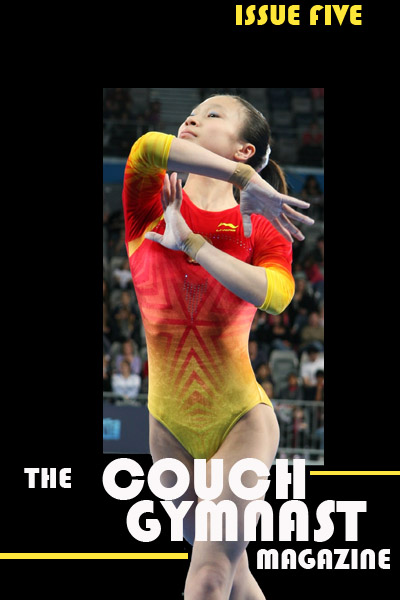
Couch Gymnast magazine #5

I’m just digging into the latest issue.

A feature discussing the reasons behind China’s slow, though deserved rise in the sport.

Interview: Chris interviewed ex-Romanian beam coach Maria Cosma, responsible for the routines of legends Aurelia Dobre and Daniela Silivas.

Interview: Marlies Rijken, Dutch National beam and floor champion talks about her life in the sport.

Justin Caouette analyses the potential of gender neutrality in gymnastics.

Interview: Meet Gina Robertson and find out what it is like to raise an international elite gymnast and keep a normal, happy family together as she talks about her daughter Brittany.

A profile on the career and potential comeback of everyone’s favorite absentee, Anna Pavlova by Suna.

Ashlyn discusses Colombia’s improvement in the sport, particualrly its two young stars, Natalia Sanchez and Jessica Gil Ortiz.

Amy is back and training again. This time at Texas Dreams. Catch up with her latest gymnastics adventures in her gym diary.

The List: Tom Lane’s late and great gymnasts of bygone days.

Italy report: Giuly witnessed some spectacular gymnastics from Italy’s 1995 babies in a recent competition.

Romania- Bea takes a look at the next batch of juniors on the way up the Romania ranks.

table of contents

Championships Gymnastics – Jim Stephenson

Ask anyone what they like about the new G.S. George Gymnastics textbook Championship Gymnastics. High on everyone’s list → the illustrations.

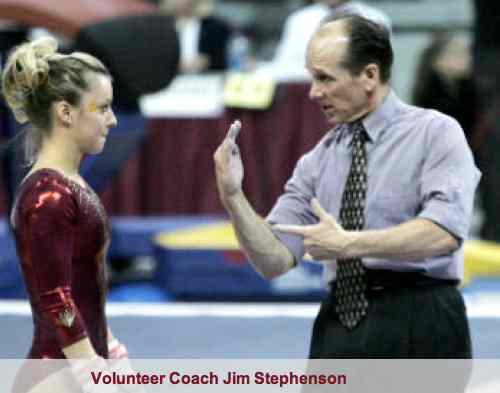
Stephenson, volunteer coach and former co-head coach for the Golden Gopher women’s gymnastics team, recently finished work on a book, “Championship Gymnastics: Biomechanical Techniques for Shaping Winners.”

Stephenson illustrated the entire book, which was written by Dr. Gerald George, Professor Emeritus in the Department of Kinesiology at the University of Louisiana. Here, Stephenson answers questions about the project, his artistic career, and future artistic endeavors.

How did the project of putting together “Championship Gymnastics” start?

“It really started in the early 1980’s, I had worked with Dr. George in creating a book called “Biomechanics of Women’s Gymnastics”. That book was probably the only book out in years that addressed so many of the important fundamentals of women’s gymnastics. We were pleased with it, but Jerry called me a couple of years ago as he was preparing to retire, and he said that he’d learned so much since writing that first book that he wanted to redo the whole thing. I was thrilled because my artwork has improved so much that I wanted to redo the whole thing too. We decided that we would make this happen. …

read the entire back story – Gopher Sports – Stephenson Completes Book Illustration Project

Thanks Roy.