A lot of creative outdoor Bar combinations.
Click PLAY or watch it on YouTube.
Hilary asks, What’s the twisting Jaeger variation bar skill at 2min 5sec?
tumbling, tramp, diving, acrobatics, circus, cheer, dance, martial arts, X sports … and more
A lot of creative outdoor Bar combinations.
Click PLAY or watch it on YouTube.
Hilary asks, What’s the twisting Jaeger variation bar skill at 2min 5sec?
Recall Alexei Bondarenko from Sydney and Athens?
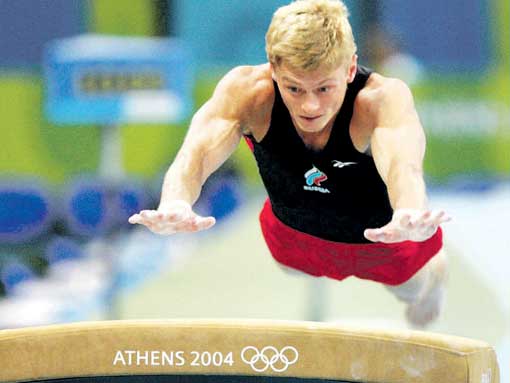
He retired after not qualifying for the Russian team to Beijing.
Now a sponsor is paying for his comeback. He moved to Round Lake (where he lives with his cat Briton) and is planning how to challenge the likes of Uchimura, 10yrs-younger.
Two-time Olympic medalist Alexei Bondarenko: I’m back!
Sovietski Sport Interview (Google Translate)
Check out a clip from TRACES, a show by Les 7 doigts de la main from Montreal, (also called 7 Fingers in USA).
Love the Chinese Hoop Diving acts. … (OK, Wikipedia doesn’t have a listing for it, as yet. YOU should write one.)
Click PLAY or watch this troupe on YouTube.
(via kinesthesist)
The registration package was just posted. Entries are being accepted starting Nov. 29th.
Kyle’s been staying up all night working on it.

photo – Phil Crozier
Kyle Shewfelt Gymnastics Festival, hosted at the University of Calgary, the weekend of March 25-27th, 2011.
Casey Jo Magee, NCAA star recently graduated from Arkansas, is training Elite.
11/9/10. First day of trying my new updated routine, minus the turn and dismount. Better execution soon to come.
Click PLAY or watch it on YouTube.
That mount, the Garrison, is named after another College gymnast who went on to captain the U.S. team at the 1988 Olympics, Kelly Garrison-Steves.
Finishing 7th on Beam in Seoul, the Garrison was in layout is called “stretched” in the Code. Tucked it just might be the Magee.
Thanks Amy for the link.
Respected expert Dr. William Sands responds to Andrew Thorton’s conclusion that at the execution score of the best gymnasts in the world has been in decline since the start of the open code. And, partly as a result, that execution scores of the top group of gymnasts in the world are ‘boxed’ between 8.5 and 9.0.
While the trends appear obvious, be aware that there is a fundamental flaw in evaluating judges – the lack of a “gold-standard” with which to compare. People have tried for decades to establish an approach to evaluate judges. Gymnastics judging immediately faces four paired problems: reliability and validity – and – cheating and incompetence. Some have argued that the actual score doesn’t matter much as long as the judges get the athletes in the right order (a sort of validity). Others have studied scores to see if the judges agree among themselves (inter-rater reliability). I would argue that the first is the most important, that the right athlete wins. The second, inter-rater reliability, is also important because when judges agree there is a tacit understanding that they’re seeing the same thing.
Unfortunately, what you often find is that people can rationalize athlete placements just about anyway they want. Both the advocate of a score and the detractor’s arguments rapidly collapse to circularity because neither has a gold-standard and must rely largely on opinion. The problem of inter-rater reliability is the very old game of “stay in range.” I think judging rules also have to combat the second pair of problems: cheating and incompetence. Fundamentally, these are unlikely to be changed by statistics.
If judges are supposed to be basically like court stenographers, then I would suggest that the “stream” of deductions and other information be recorded in terms of time on their computers. Clearly the technology now exists for this, and has existed for some time. Moreover, the tenets of systematic observation have been well known in scientific circles for decades. In this way, judges not only have to stay in range with their total score, they also have to be deducting for the same things (as seen in their time-based stream of data). I think editing should be allowed, in other words, the judge should be able to go back in the stream of his/her writing and add-in or change things that he/she couldn’t write fast enough or he/she simply changed his/her mind at the end. The original data stream is always preserved however, so that any changes are recorded as changes. However, once completed by the judge and scores are “locked” then the overall analysis of judges can proceed in several dimensions simultaneously and could serve as both an evaluative and educational tool for judges. For fans, the stream could be displayed in real time and finally reduce some of the mystery of “how on earth did they get that score” for fans.
I realize that to think this is likely to be implemented is naive. However, if you check the judging literature, you’ll rapidly find that these same issues have plagued judging since at least the 1951 (in my personal library), and probably before that.
All the best.
Wm A. Sands, PhD, FACSM, C-ARS, NR/WEMT
Bill’s now Director at the Monfort Family Human Performance Research Laboratory in Colorado.
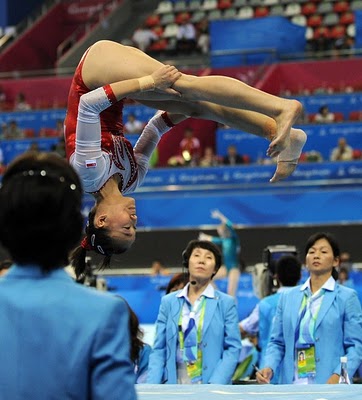
On Vault I think we should judge exactly like they do in Diving. No paperwork. One number for execution is flashed immediately and transparently in real time.
On the other apparatus it might be possible to use an iPad or keyboard to record in real time. I recall an American MAG judge who used a keyboard to both record skills and execution on Horizontal Bar. It looked very accurate to me.
Bill’s citations on the gymnastics judging problem(s) are posted in the comments.
Merly de Jesus from Brazil competed it (easily) in 2004.
Click PLAY or watch it on YouTube.
Lucas from Brazil tells that she’s back training again.
I’ve previously posted Mack Brannan training it.
selecious linked to that video on an IG forum new skills thread.
Other cool skills linked include London Phillips double layout 1/2-out (2005)
She later went on to Fullerton.
And check the Bars dismount by Geng Ruowei (2008). (The most flexibility I’ve ever seen on that apparatus, I think.)
Others include the very cool Beam routine of Kim Bui (2009).
There’s more on Skills you’re shocked gymnasts haven’t done
Bart Conner Gymnastics Academy in Oklahoma offers a free class, once a week, for autistic kids.
Nice.

… “The gross motor development skills, that’s what we do,” said Ben Fox of Bart Conner, who, along with Ann Goff, gym teacher at Lincoln, originated the idea to offer these free classes to Norman Public Schools’ students who are identified on the autism spectrum.
“It’s great for motor and language skills, and they’re having fun while learning. That’s what kids like to do … run … jump,” Fox said, motioning toward one of the students, Isaac, as he jumped in circles on the trampoline …
The skill is named after Daiane dos Santos in the WAG Code. But Blythe Lawrence reckons the first to compete it was American Lisa Marzan in 2001.
Leave a comment if you can recall seeing it earlier than that.
Click PLAY or watch a Mostepanovafan montage on YouTube. (Dec. 2009)
I still love this skill in women’s gymnastics. But variations are getting over popular on the men’s side.
(via Gymnastics Examiner – An encyclopedia of Arabian double pikes)
Online I’m seeing a lot more Women’s Collegiate gymnastics content, especially videos from training. Interest is picking up in advance of the season start in January.
gymdandee on College Gym Board linked to “10 NCAA gymnastics fluff, intros and otherwise” videos.
Most are way over the top. This was my favourite of the bunch.
Click PLAY or watch last season’s Oklahoma Intro Video on YouTube.
One of the Utah videos from last season has some cool computer graphics I’d never seen before.
 Gymnastics Coaching.com