Five athletes and one coach comprise the 2011 class of inductees for the USA Gymnastics Hall of Fame: 1972 Olympian Jim Culhane of Tomball, Texas (men’s gymnastics); six-time world tumbling champion Jill Hollembeak of Chicago; 1992 Olympian Tamara Levinson of Los Angeles (rhythmic gymnastics); 2000 Olympic team bronze-medalists Kristen Maloney of Dover, N.H., and Elise Ray of Reisterstown, Md., and 1988 Olympian Chelle Stack of Clermont, Fla. (women’s gymnastics); and coach Stacy Maloney of New Berlin, Wis., who coached 2004 Olympic all-around champion Paul Hamm and his twin brother Morgan, both of whom competed in the 2000 and 2004 Olympic Games. …
Congratulations to Stacy Maloney. This is well deserved recognition.
It’s timely to revisit Stacy’s opinion of the NEW Code … in 2005:
This new system will do three things:
>> First, it will encourage a proliferation of even more difficulty in an already brutal and dangerous sport— …
>> Secondly, it will disorientate a public whose only reference point for understanding what they see at a meet is how close the score comes up to a 10.0. …
>> Thirdly, think about how such a monumental change will affect your businesses—imagine trying to explain it all to the parents and kids. It will most likely impact our livelihoods in a very negative way. …
Podium training in beautiful, mellowLong Beach, California.
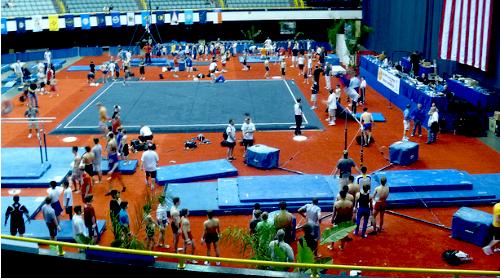
With 700 male gymnasts (ages 12-18) at MAG J.O. Nationals, the competition gym is crowded. I saw 25 guys waiting their turn on Horizontal Bar, at one point.
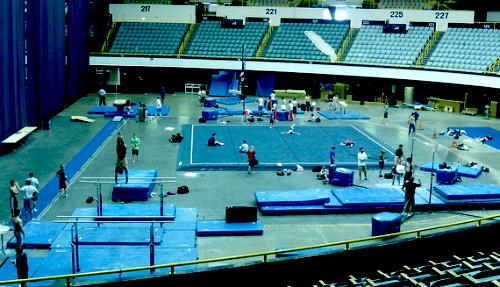
Yet the “open” training gym has been fairly quiet. (The guys are here today mainly to feel the competition apparatus.)
My job as a mom is not to raise a child, but to raise an adult. The whole process is overwhelming and seemingly impossible. I mean seriously, I can’t even train my dog to come when called. How in the world am I going to raise daughters who are independent, honest, self-assured women of their word who also show compassion, selflessness and unconditional love to their fellow human beings?
When DW and I put our kids in sports it was for a handful of teachable moments: leadership, teamwork, mental and physical strength, how to be competitive. …
Hard to believe that's my kid!
… I would say that two of her coaches have surpassed any of my expectations and been more like mentors than coaches. …
The Chronicle of Higher Education is the major news service in the United States academic world. 68,000 (subscribers); 245,000 (total readership)
Rumour:
Rhode Island Collegeannounced that women’s golf and women’s swimming will be added as varsity sports for the 2011-12 season. The sport of women’s gymnastics eliminated.
But I’ve heard that the team is fighting for survival. And might yet survive. Leave a comment if you know more.
… I want to share a story of triumph and the ability to beat all odds. One with medals and moments of happiness, and one of heartbreak and helplessness. Its a story of a gymnast who has had to embrace set backs as part of her life to her journey of making it to the collegiate experience.
Chayla Nelson is a level 9 gymnast who trains at KAATS Gymnastics and is coached by her mother Kathy Nelson. Born and raised in Matorville, Minnesota, she lives only 30 minutes from Mayo Clinic Hospital in Rochester where she was born, and would spend much of her time in growing up. …
Mas Watanabe reports that of 13 healthy Level 10 gymnasts at the beginning of season, only 2 are “healthy enough right now to train hard without taping or icing and some type of rehabilitation”.
… There are only days left before J.O. Championships.
… The most areas of injuries were from 2 main areas: legs (ankles & knees) and the lower back.
Also, many of the injuries were chronic type injuries, so they could train, but working with some aches and pains. Some injuries require the support of athletic tape or supporter during the training and constant rehabilitation work. …
photo via Gymnastics Alberta
Gymnasts being injured (or not nearly 100%) for their peak meet seems to be more common today, than in the past. Frustrating for both the coach and athlete.
Some kids find themselves in this situation year after year.
Solutions?
Firstly, we should study gyms that don’t have this problem. Two clubs that jump to mind are Geddert’s Twistars and Oakville. Both have a lot of Level 10 and higher gymnasts who actually show up at every meet, and both clubs keep their older kids training. What are they doing right?
Next we should look at the last 5 weeks before the peak meet. The main goal should be to avoid injury. And stay healthy.
Obviously, a taper in volume will help. Decreasing difficulty, if possible, will help. Modifying landings. Safety spotting, especially at team training camps.
It’s as important to be healthy for the Peak meet, as ready.
… Leave a comment if you’ve any other recommendations.