This seems to be a courage test at the Salta – Ortona Training Camp in Medicine Hat, Alberta.

Who’s going to jump first?

tumbling, tramp, diving, acrobatics, circus, cheer, dance, martial arts, X sports … and more
This seems to be a courage test at the Salta – Ortona Training Camp in Medicine Hat, Alberta.
Who’s going to jump first?
Gymnastics Examiner:

The biggest shock of the junior women’s preliminaries was the disastrous beam performance of all-around favorite Jordyn Wieber, who fell three times during her routine, including landing her double back dismount on her head.
Wieber’s beam routine followed a fall on a Tkatchev on bars. Those performances from the former junior national champion considered one of the top gymnasts in the world, coupled with her two heavily taped ankles and her withdrawal from her last event, floor exercise, caused reporters to huddle around her when she came out of the trainer’s room …
What happened? everyone wanted to know. She told us. …
click through to read the interview – After ankle injury, Jordyn Wieber’s status uncertain
The leader after day one is defending champion Kyla Ross, who was the only top contender to avoid a major mistake. After four clean routines, Ross is ahead of the field by just over one point.
WOGA’s Katelyn Ohashi used her beautiful form and flexibility, along with considerable difficulty, to overcome falls on bars and beam (where she missed her trademark layout full tumbling pass) and claim second place. …
Universal Sports – Wieber falters; Ross leads juniors
Almost anyone would say … YES.
But Andy Thornton says, not as weak as you might think.
Why all the distress, then?
… The answer is He Kexin, the Chinese phenom who popped up in 2008 with the best bar routine the world had ever seen. Though she’s equally well known for the worldwide skepticism she generated regarding her true age in Beijing, it was her out-of-this-world bar routine that began to spread worry among USA gymnastics fans – and the USA women’s selection committee.
Before He Kexin came along, the USA had beaten China on bars in 2007 and finished just 0.025 behind them in 2006. But with China’s new secret weapon and the full point or more she surely would add to their team tally, the USA was going to have to have to come up with an answer very quickly. Even with three hit sets in Beijing from Liukin, Memmel, and Johnson, the USA was outscored by 1.65 on bars by China – a big reason why China won the Olympic team gold. …
It’s now two years later, so how have things changed? With Nastia Liukin out of the picture, her WOGA teammate Rebecca Bross has filled in beautifully as the top American on bars. Her high D-score of 6.2 and aggressive and confident style have made her one of the best bar workers in the world over the last two years, and her consistency as only gotten better. …
read more on the American Gymnast blog
Great analysis. Thanks Andy. … But I still believe the USA will be far behind both China and Russia on Bars at World’s 2010.

Mainstream media love to do these stories. This one is more balanced than usual.
Mail Online:
It’s enough to make any parents grimace as these Chinese children are contorted into the most uncomfortable positions.
Aged between four and seven, the young gymnasts are put through a rigorous stretching routine by their coaches during a training session. …
Read more: Hang in there: How children as young as four are stretched in training to be China’s future gymnasts

I was happy to see coaches doing handstand on a floor bar, rather than flat-handed. This will help prevent overuse injury to the wrists later in the career.

Thanks Jeni.
 Full In Full Out posted another in the Know a Coach series, this time American Hall of Famer Mary Lee Tracy.
… Currently, Tracy trains Cassie Whitcomb, an athlete known for her lovely, increasingly difficult bars work; Amanda Jetter, who recently took the silver medal in the all around at the 2010 Covergirl Classic; and several talented juniors, including Lexie Priessman, who took the all around title at the first ever Nastia Liukin Cup in 2010.
She also took in a gymless Kayla Williams, 2009 World vault champion, though injury forced Kayla to retire from elite competition and focus on her upcoming NCAA career. …
read it all – Know a Coach – Mary Lee Tracy
Mary Lee has a number of coaching videos available from GymSmarts.com.
An oldie, but a goodie.
Keith Russell, current President of the FIG Scientific Commission, wrote this decades ago. Advocating to keep some kind of gymnastics in school Physical Education. A losing battle, I fear.

… The most useful aspect of the “Activity of Gymnastics” is the principle that you teach a student to control their own body in a variety of situations; while doing various locomotor activities: swinging, springing off hands and feet, balancing, landing etc and while on the ground, off the ground, right side up, upside down etc. …
It seems quite reasonable to assume that if students can first control and manoeuvre their own bodies with a fairly high degree of skill then they can subsequently better control and manoeuvre themselves PLUS an implement (bat, stick, racket) or themselves plus a projectile (ball, discus etc). Likewise, they could then better control themselves in various mediums (water, snow, etc), or better handle themselves PLUS an opponent. …
Keith also developed the Up Down All Around lesson plans, the best school gymnastics resource anywhere.
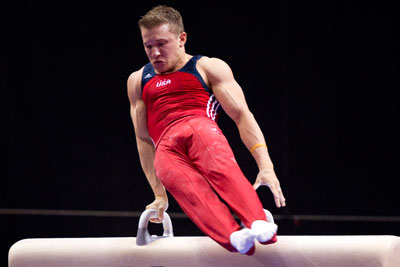
He hit pommels! …
… 2008 Olympic silver-medalist Jonathan Horton of Houston came from behind to take the lead after the fifth rotation in the men’s all-around with a score of 90.350 on the first night of the senior men’s competition at the 2010 Visa Championships at the XL Center in Hartford, Conn. …
read more on USAG
Danell Leyva is in second place. … Chris Brooks down the list.
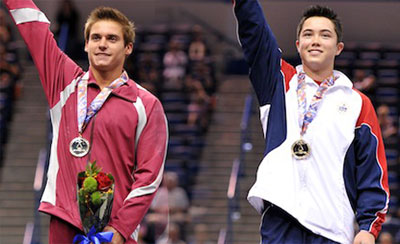
Sean Melton of Orlando, Fla., and Sam Mikulak of Corona del Mar, Calif., won the 14-15 and 16-18 junior men’s U.S. all-around titles, respectively, at the 2010 Visa Championships at the XL Center in Hartford. …
Read more on USAG including links to full results
Gymnastics Examiner:
Wednesday night, the 2000 U.S. Olympic team — Tasha Schwikert, Elise Ray, Kristen Maloney, Dominique Dawes, Jamie Dantzscher, Amy Chow — received in Hartford the bronze medals they had earned in Sydney. …
The U.S. was awarded the bronze in April after a lengthy investigation by the IOC and International Gymnastics Federation concluded that China’s Dong Fangxiao, who was supposedly 17 in 2000, was actually 14. …
Ten years after the fact, the 2000 women’s Olympic team receives their bronze medal
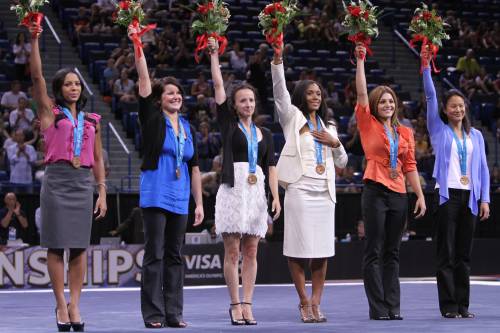
Reaction has been mixed. Many people, including me, are more interested in the consequences of China losing than the USA winning the team medal.
Will this prevent future age falsification?
… Let’s see what happens at the Youth Olympic Games.
His first meet back from major knee surgery.
Good luck! … But simply getting back to that level of competition I’d call a win.

Sho’s blog – Game Time
Having graduated Stanford, he’s now now training with Chinese-born Zhang Jinjing, a 1996 Olympian and the 1997 world champion on parallel bars, at Champions Academy in Morgan Hill, Calif.
 Gymnastics Coaching.com