
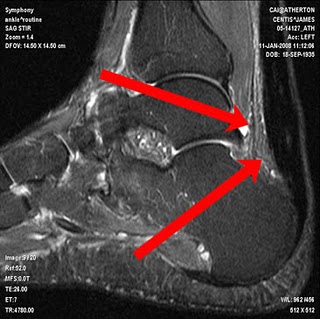
Could the use of platelet-rich plasma help reduce the number of Achilles tendon injuries in gymnastics?
One older Canadian gymnast tells us it worked for her. She linked to a YouTube video doctor’s description of the procedure.
Platelet-rich plasma (PRP) is blood plasma that has been enriched with platelets. As a concentrated source of autologous platelets, PRP contains (and releases through degranulation) several different growth factors (cytokines) that stimulate healing of bone and soft tissue. PRP has received popular attention due to its use in treating sports injuries in professional athletes. …
When something sounds too good to be true, it usually is …
From a recent NY Times article:
… Its appeal only soared higher when professional athletes like Tiger Woods and the football players Troy Polamalu and Hines Ward reported that it cured them.
It is a new procedure, based on an idea that once seemed revolutionary: Inject people with their own blood, concentrated so it is mostly platelets, the tiny colorless bodies that release substances that help repair tissues. …
Now, though, the first rigorous study asking whether the platelet injections actually work finds they are no more effective than saltwater. The study, reported in the Jan. 13 issue of The Journal of the American Medical Association, involved people with injured Achilles’ tendons, fibrous tissue that connects the calf to the heel bone.
“We are sorry for the patients,” Johannes Tol, the lead researcher and a professor of orthopedic research at the Hague Medical Center in the Netherlands, said in an interview this week. “There still is no good treatment.” …
read more – Popular Blood Therapy May Not Work
That doesn’t mean coaches shouldn’t still consider the option. Many have reported success. But there’s no evidence yet that it actually works.
Note that there’s a slight risk of testing positive for a doping infraction after this treatment.
Leave a comment if you’ve had any personal experience with PRP.


4 comments ↓
I received a PRP injection for chronic plantar fasciitis that had not been relieved with any conventional treatment, and had recently ruptured. It did not prove to be effective in my case.
I believe PRP is a promising treatment that shouldn’t be ruled out. However, more research is needed on the circumstances under which it is most effective.
The long recovery period coupled with the experimental nature of PRP will likely deter most athletes at this time. If other treatments have failed, however, there doesn’t seem to be any risk associated with giving PRP a chance.
I have quite a bit of experience with these injections. Johannes Tol is widely respected in the world of orthopaedics and has produced quite a bit of excellent research with Nick Van Dijk on ankles and Achilles tendons. He is correct. There is no great research out there suggesting these injections work. Unfortunately, there is not even an agreed upon concentration (how much platelets in the injection vs how much is normally found in the body). That is not to say that I haven’t seen success with the injection in a handful of individuals. It must be noted that with this injection it is recommended the athlete avoid activity for some time. This rest may well help with the success of this treatment. Also of note PRP is currently very expensive particularly in the United States.
Lastly, PRP injection is not allowed into muscle by WADA, but I believe everything else is fair game.
Fascinating! So glad the commenter posted about her experience and you then researched it!
Hello again. I have definitely heard that this treatment does not work for everyone. I think it also depends who is doing the treatment and how knowledgeable and experienced they are. I had a 4D ultrasound before every injection to determine the exact area and depth the injection should be. I also did not require any time off although it was quite sore immediately following. I went recently to have a second one done for my achilles and following the ultrasound, the doctor said the tendon looked much better from the previous injection so it would not be necessary. I was relieved to know that the tendon did not look degraded and that the treatment had been working. I know this procedure may not help everyone, but I thought it was a lost cause for me until I traveled to have it done. Hopefully more testing can be done to determine whether it is a valid and reliable method of treatment. Thanks Rick for posting that information from both sides of the fence! I think it’s important for people to know both!
Leave a Comment