I’ve added a link in the right hand navigation to the best new gymnastics coaching manual in years.
Dwight Normile’s review on International Gymnast:
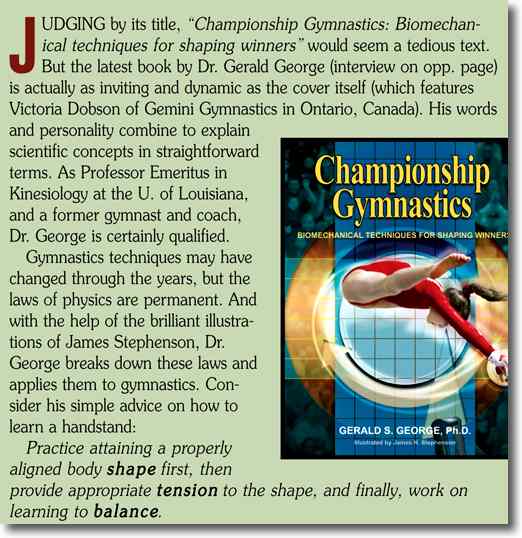
Click through to read the rest: June – Chalk Talk – ‘Championship Gymnastics’ Scores Very High Marks
That link takes you to the online magazine.
I’ve talked to several coaches who bought a copy. Reviews are unanimously good, especially for the illustrations.
They grumble about the price ($79) … but agree the 280 page text is excellent.
Order it from the official website – Winning Gymnastics. Or phone 888-796-5229.
Or you might try to catch Dr. George at one of his seminars this summer.
Or … you could get the dead tree June edition of International Gymnast magazine.
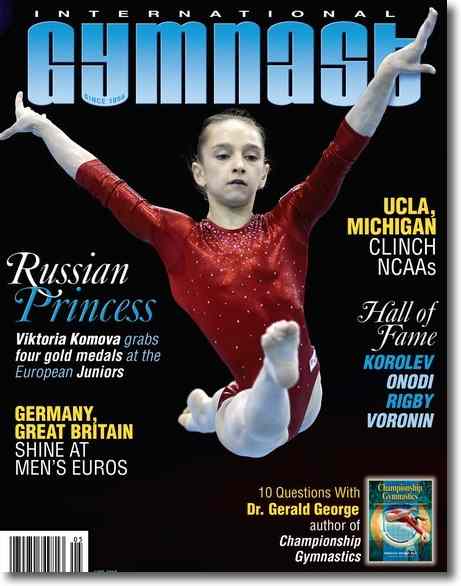
Komova’s on the cover. Good call!


17 comments ↓
I know you really prefer topical update posts, rather than deeper analytical posts (at least for yourself!
, but it would be interesting to read some comparison of all the books out there. Like if you were outfitting a library, which first, second, which hit which areas, where you would choose one of two. Etc. Etc.
P.s. I’m thinking of buying this book: http://www.exrx.net/Store/HK/StrengthTrainingAnatomy.html
Seems pretty cheap and would be a good desk reference for me. And with getting more and more into lifting (intellecually as well as exercise), it’s helpful to understand what all the different muscles are in your quads, hamstrings, calves. Which go over one joint and which over two, etc. etc.)
Actually I feel like I’ve learned more about biomechanics from lifting websights than gym sites.
How do they sell that text for US Price: $19.95?
Nice.
Biomechanics has really fallen out of favour in gymnastics coaching circles. Many of the best coaches don’t know, and don’t care. It couldn’t be all that important.
I think it’s because they are training young athletes (who are more bouncey and disposable and less self-aware). I think when you are an adult, doing your own training and really getting into it and getting through injuries and the like, you get more into the science of it.
I also think there is a huge opportunity for more sports science in gym. And I don’t mean biomechanics in the sense of some complicated motion (like tapping for releases or the like). I’m talking more simple things, like how to optimally gain strength (how much recuperation is needed, etc.). Or even understanding the different types of muscular injuries and dynamics in your calf (when is the soleus involved and when the gastroc). I find way better amateur and professional understanding of these things in the weightlifting crowd than in gym.
I also think diet and nutrition are an untapped frontier for better performance of gymnasts. Obviously being lighter helps (especially for women, but even for men). However, there can be a lot of science in how to manipulate your weight most effectively, so that you lose the least strength while cutting. I think gym just kind of goes after these things with brute force and lack of real tthinking. how many gymnasts understand the dynamics of cutting water associated with glycogen for instance.
It’s not exactly the same problem (never is, accross fields) as bodybuilding, but there are insights gym could use if they want to be more competetive. If some national team, really wants to win, they will start getting superscientific about this stuff to go after every edge available. Look at how Lance and the US cycling team went after ever edge possible (best bikes, best technique, wind tunnel testing, right masking agents, etc. etc.)
I totally cringed when I saw the video of that fat femal coach giving paid instruction to gymnastics coaches at a training seminar saying “there’s this ahum P-90X thingie”. It was buttobvious that that lady didn’t even have the context to know what she didn’t know!
“Biomechanics has really fallen out of favour in gymnastics coaching circles. Many of the best coaches don’t know, and don’t care. It couldn’t be all that important.”
This made me cringe so hard.
EVERY coach should have at least a basic understanding of biomechanics.
And throw a full twisting Thomas.
Regarding the comment: “Biomechanics……….Many if the best coaches don’t know, and don’t care. It couldn’t be all that important”.
I suggest the we always hold dear the words of a humble man who sought to answer life’s tough questions,
“If I have seen farther, it is by standing on the shoulders of giants.”
Issac Newton, circa 1676.
Haha, no, that part’s optional.
Strength Training Anatomy does show many of the major muscles that activate during various exercises, but like most bodybuilding-type books, it fails to address true movement.
Muscles do not work in isolation. Rather, they co-contract and function together to produce patterns of movement. So, training muscles in isolation is no way reflective of how we move. Nor does it offer much application to sport. Plus, most books fail to recognize or the authors probably don’t even realize that some muscles may even change function depending upon the movement or a specific range of motion within a movement.
Unfortunately, there is no book that offers a nice collection of such that I have ever found. If you have any level of basic anatomical understanding, I’d recommend pursuing books related to physical therapy to understand more of how the body truly operates from a functional perspective.
I haven’t read the strength training book yet, but I mostly just want it for the ready desk reference. Hate having to look up what is the ilio and all that.
Also, I think you might underestimate how well weightlifters understand movement affecting muscle utilization. First, most of them adovcate compound free weight movements. Some of which, like squats involve the paradox of opposint muscles working together.
Just look at the content on the exrx site. all the lifts, they talk about main muscle, synergists, stabilizers, etc.:
http://www.exrx.net/WeightExercises/BackGeneral/CBStraightBackInclineRow.html
Obviously there are some complicated aspects of biomechanics in movement sports, not captured in these exercises. but you should lknow this stuff as a foundation and then add the movment aspects. And I don’t think gym people know even the somple stuff well. how many can tell you the different muscles in the mid-back and what types of movements engage which of them?
spam stopper
OK. Here is another good write up:
http://www.exrx.net/WeightExercises/HipFlexors/CBLyingLegRaise.html
See all the detail…
Thanks for the link Poly(what does the whole name stand for anyway??). I’ve been trying to figure out why I’ve been having some hip/hamstring/sciatica-like pains lately from workouts which have included lots of weighted lunges and ab crunches- and then I go to my adult gymnastics class and do lots of bridges and leg raises (with the waist flex mentioned in the link) and temporarily feel better. If I’m understanding it correctly, the link is saying that you need to be moving your waist to completely get the full abdominal and hip flexors stretch and strengthened, which is good to know.
I don’t understand why gymnastics coaches wouldn’t be all over learning the intricacies of this stuff, either (other than it’s difficult). Obviously as an adult doing gymnastics, these little mistakes in training affect my body in a much more obvious way, but with all the injuries that happen with gymnasts, I would think paying closer attention to them would help prevent them so much more. Weird.
Yes, I have been to ExRx before. There are some good things about that site. It’s better than most. And, yes, compound movements are better than isolated movements.
I’m just telling you that Strength Training Anatomy isn’t anything special. I could give you a list of very good resources if you’d like them. You’ll not only learn about anatomy, but you’ll also learn a lot about dysfunctional movement patterns, muscle imbalances, etc.
Besides, if you look hard enough – you can find Strength Training Anatomy for free in e-book version online. Go search Rapidshare or do some PDF searches. Save your money. It’s out there, I’ve seen. But, I’ve never had the desire to download it because it’s really not that great in my opinion.
By the way – you’re talking to someone who has a pretty advanced education in this area and who studies training extensively. There are some weightlifters who know a lot. But, there are others who are completely clueless and use Muscle Mag as their primary source of training education.
Perhaps I overstated saying: “Many of the best coaches don’t know (biomechanics), and don’t care.”
… OK, I overstated.
It’s true that many of the top coaches in the world do not understand biomechanics. It’s not much appreciated in the Chinese coaching system, for example.
It’s also true that those coaches would be better if they did understand biomechanics. I wish they did.
Personally I like biomechanics. And, in fact, taught it this week at a coaches course. In 2010, however, in Canada we are using a simplified biomechanics, not the excellent but complicated system in our manuals, originally written by Tom Kinsman.
In the past biomechanics discussions produced “more heat than light”.
We had none of those in the course this week.
Chris: I am an amateur. Never even had a course in anatomy. I am just starting to learn about some of this stuff. I even read my PT’s books in his office before going in for rehab. I’m not trying to say that book was the end all be all. And of course, there are very complicated things going on in gait for instance.
I would love it if you recommended some books for me, simpler starter stuff would be better.
I’m not going to steal the PDF. I don’t mind paying the 20 bucks, having a good printout. Heck the value of my time that I spend trolling (ahem) reading…the Internet, is way more than the 20 bucks. Actually just giving up drinking has saved me so much money…and also made my trolling less over the top.
I learned bio-mechanic principals by watching and paying attention to gymnastics over years and years and years (and listening to more learned coaches than myself). By the time I got hold of a technical manual of any kind I realized I learned a lot just by figuring it out on my own. I would certainly enjoy some courses and some more technical information, which I can only do so much by reading on my own.
I’m in the same boat as TP.
Leave a Comment