
Posted by JennFyre on the IG Forum:
1) Compulsories
2) The perfect 10
3) Team competition where everyone on the team has to contribute and it was more then 3 kids from each country have to win a team title.
4) Artistry!!!
5) I miss when the guys didn’t look like they were going to die 5 skills into their routine.
6) When AA guys didn’t have a VERY weak event.
7) The little transitions on floor when you could tell the stylish from the rest.
Dance in between the skills on beam and floor.
9) A leap that does not have a switch leg or ring shape in it.
10) Mounts that look good on beam.


14 comments ↓
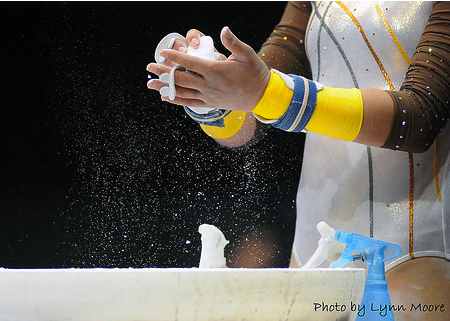
Hey, I took that picture at Nationals
I’m glad you like it.
Lynn
I, for one, LOVE the open-ended system. Does it need some tweaks? Yes, of course. It’s brand new; it’s not going to be as well-rounded as a system that’s been refined for decades, such as the 10.0 system, but give it time. The concept has some major advantages, chief among them that athletes can continuously push themselves and the sport forward. The lack of a max score means there is always something that can be added.
It has always been my philosophy that perfection does not exist in gymnastics. Something can always be better, higher, more beautiful. There are no limits to these things, and a score that reflects this makes sense.
I also don’t miss the dancy-stuff on floor in men’s routines at all. I mean, that’s probably the entire reason men’s gymnastics developed such a stigma in the first place; if male gymnasts are jumping around like ballerinas, of course idiots are going to label them as “gay.”
Modern men’s floor routines are the acrobatic art of gymnastics distilled to its most crucial element; the acrobatics! Floor routines without any of the pointless fillers are much more exciting to watch.
As I said, the current system is far from flawless, but that’s to be expected; it’s a new system.
Thanks Lynn. It’s very evocative.
Of course you’re right Geoffrey. But it also means that ultimately difficulty will win out over artistry. I heard that the Chinese system completely changed the kind of kids they look for in talent I.D. when the code went open ended.
If you like artistry, in 5yrs or so, you may need go watch some other sport.
Did Gilbert write the title of this? “gymnastic” sans S?
Sorry Rick, had to comment on it!
The athletes continuously pushed forward in the 10.0 system too. You don’t need open ended scoring to accomplish that.
I’m agree.
Gilbert is writing this!
Sher, the mere point value is effectively meaningless at the elite level. Given most athletes scored, in the 10-0 system, between 9.8 and 10, they weren’t really even operating on a 10-0 system comparable to the JO system (where girls will score sixes, eights, nines, etc.) but rather a point-2 system. They could have lopped off all the 9s and scored the girls between a .000 (for any girl who fell or otherwise was simply not in contention) and .2, for the first place girl with a perfect routine. The numbers only mean anything because they meant something at some point in history when you first learned about the sport. Imagine if a touch-down in football were suddenly changed to 30 points instead of 6, and every other score increased by a factor of 5 as well. Would football fans be upset? Maybe initially, because it’d be meaningless when compared to historical scores, but new fans coming up wouldn’t care, and as long as the better team scored more than the other team, the win would be right regardless of the number next to the name. Scoring is scoring, they could give you shapes instead of numbers, it doesn’t matter. First place gets rewarded a triangle, second place gets the color orange, as long as we know what the scores mean in relation to each other at an individual meet (i.e., triangles beat orange, orange beats the letter Q, Q beats Love-15), it could change every single time and it shouldn’t make a difference. The girl could finish her routine, salute the judge, and wait for her “score.” The judge writes something down, hands it to the flasher, and if the flasher holds up a flaming bag of poop, nobody should care so long as they know what a flaming bag of poop means, and if it means “you’re in the lead,” then that gymnast is going to be happy, regardless of it being a flaming bag of poop.
Now, you can say “the people don’t know what the scores mean,” and that may have been true initially. But come on, this has been 4-5 years now. It’s really not that hard to figure out, and anybody who hasn’t figured it out either can’t do math or just isn’t trying very hard.
The issue therefore, can’t or shouldn’t be with what numerical value they attribute to the girl in first place, but rather HOW they evaluate the routine, what they judge, what they look for, etc. For that, you can criticize all day long, and while I might be inclined to disagree, I can concede that the opinions of what is important in a WAG floor routine are going to be as varied as the girls performing them. So in that regard, all this sport can ever do is adjust, tweak, modify, and just like the gymnasts themselves, try to be better the next time.
*Sher, that last post shouldn’t have been addressed specifically to you. I started with a reply to you, then deleted it, and must not have highlighted that entire paragraph. My apologies.
I’m a fan of the open ended system, but I do feel like routines have so much crammed into them that they aren’t as much fun to watch sometimes.
Her #1 and #9 above are pet peeves of mine as well. I think it’s really beautiful to watch an elite, olympic caliber athlete executing A & B level skills with amplitude and perfect execution that goes beyond what the normal athlete can do. It’s nice to see a gymnast show mastery of the gamut of gymnastics skills — not just the elite level skills.
There’s always a trade off though. Competitions tend to be long and tedious when compulsories are included. Overall, I think its the right decision to not include them as part of the competition, but I miss seeing those fundamental elements being performed by everyone and the opportunity for direct comparison of apples to apples criteria for all of the athletes.
Gawd, I don’t miss Compulsories at all !!
How do compulsories make competition more fatiguing than a round of optional routines? If anything it is more restful to compete your basics. Compulsories are beautiful – always looking for that one gymnast per team that can really pull them off. Who had the best bar, beam, floor routine that night – the best vault? It’s much more cut and dried in compulsories.
The average person does NOT want to try to figure out the new system. They want to tune into a gymnastics event and know how everyone is doing just by seeing a score. I am not saying it is right, I am just saying that the new system alienates potential new fans and it rewards chucking and cramming rather than showing true mastery.
The 10.0 system worked just fine if judges KNEW HOW TO JUDGE and took off the correct deductions for EVERYONE, including the “favorite” countries.
I like open-ended scoring, but there really needs to be some changes. First, only the top six skills should count towards the D score.
Also, I don’t like the “OMG! I don’t understand the scoring at all!” thing. Casual viewers just need to know that more difficult routines will get higher D scores. The big problem is that casual viewers could be confused by the gap between scores on different apparatus.
Also, I think I found inspiration for my first blog post in a while.
Leave a Comment