
Inside Gymnastics published the best article I’ve seen so far on changes to Collegiate Women’s Gymnastics:
Women’s collegiate gymnastics coaches made the first move to radically overhaul their sport at their annual college coaches’ meetings, held in conjunction with the J.O. National Championships in Washington earlier this month.
After more than three days of heated discussion, the women’s National Association of Collegiate Gymnastics Coaches voted to vastly change the NCAA competition format.
First, by adopting a six-up, six-count scoring format for all collegiate competitions and second by reducing the NCAA finals, currently known as the Super Six, to four teams and, if warranted, moving the meet from Friday night to Saturday afternoon in the hopes of gaining live TV coverage from rights-holder CBS. (Twelve teams would still qualify to NCAAs, but only the top two from each prelim session would advance to finals and compete for the title. Regional qualifying would remain the same.)
The latter measure, which reduces the number of teams in finals by two, passed almost unanimously (only one coach, in the end, voted against the radical reduction), while the six-up, six-count scoring idea received only a simple majority.
Both changes are the brainchild of Utah coach Greg Marsden, winner of nine NCAA titles and a passionate advocate for making his sport more accessible to the public. …
It turns out that Florida coach Rhonda Faehn was the sole vote against the 2 main changes.
Florida hosts Championships next season.
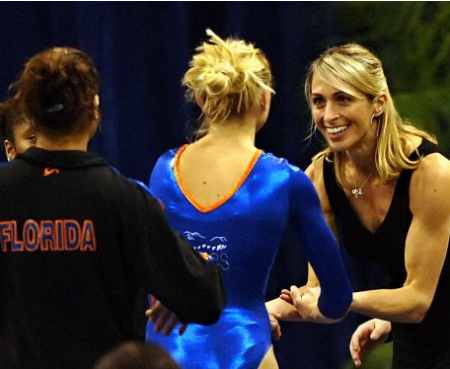
photo from Whatever Happened to … Rhonda Faehn
We won’t know until sometime later in the Summer if and when the changes will come into effect.
Many predict they will not be ratified by the NCAA.
I could see the 6-up, 6-count being put into effect soon. The change to a Super 4 Final being made contingent on a TV contract.


0 comments ↓
there are so many things I want to say about this, but I can’t even put it together right now, this is all just a REALLY bad idea
my first thought is mid routine injuries…just think about that one…
Team loses, I assume, Marcus.
As in FIG.
Recall when the Russian girl took zero on Vault. That was it for the Team competition.
The “first” move in a radical overhaul? What else are they planning on doing?
I talked about this with a college coach this weekend, and she brought up a point or two I hadn’t considered:
If you think that NCAA routines are predictable or unoriginal now, it will only get worse if there’s no dropped score because there will be no incentive to do anything beyond the safe minimum. As of now, in theory, (though not necessarily in practice as actually rewarded by judges,) in *theory* big routines with big skills should impress the judges and somehow get rewarded in the scoring compared to watered-down routines that just meet the minimum requirement for a 10-0 start. I’m not sure this “rewarding” is exactly technically permissible, I’m not familiar with the NCAA code or judging procedure. But either way, the point is that schools like Utah and Georgia, etc. likely have the kids who could easily water down a routine and do it perfectly, and another school whose only shot was to throw the big stuff (god willing safely and effectively) and use the WOW factor to boost them up won’t have a chance. This would have the exact opposite effect of “opening up” the competition. Now sure, you could argue that the team which performs 6 perfect routines per event deserves to win, and maybe it does. But it’d be a compulsory meet, for starters. And it certainly won’t have the attention-drawing impact they want it to with lay fans now that no one has an incentive to do anything dynamic.
I’m not convinced that’s necessarily incorrect, and if it is true, then I’d recommend that there should be some adjustments to the value system as is. If it is so easy for every girl to water down a routine and still start from a 10, then I think that’s an issue of concern right there. The “bare minimum” required shouldn’t get to have the same start value as something “bigger” or “better.” I don’t know that I’d go to the open scoring system either, though. Obviously, value has to be set and determined somewhere, and that’s going to fall on one side or another of a girl’s ability. But altogether, I think it might help separate some scoring if 1. the judges judged more critically so that it wasn’t a stick-competition, and 2. the incentive is still there for teams to work on dynamic skills to achieve the higher start value.
Lay fans think a cartwheel is spectacular. “Watering down” if it happens, probably isn’t going to bother them.
I disagree entirely Sher.
In real life, done before their eyes, by friends they didn’t know had that talent, maybe. But on TV, by “professionals” or the nearest equivalent our sport has, not live, they expect the same daring feats that give rise to the popularity of the X-Games, etc.
If a cartwheel were enough to gain their attention, the sport would have wider viewership than it does.
And even if they don’t get bored with the excitement of the skill, they will get bored with the lack of variety. A compulsory meet is mind-numbing to those not in the know, and often mind-numbing to those in the know.
Imagine a slam dunk competition where everyone did the same dunk, all the time. It’d be terrible, no matter how excellently executed the dunk *actually* was. Fans wouldn’t appreciate it.
I don’t necessarily agree that it will happen, but I do agree if it does, it won’t be helpful to the sport’s popularity.
yeah, and I don’t think that NCAA should be anything like elite, I never liked 3 up 3 count
“Lay fans think a cartwheel is spectacular. “Watering down” if it happens, probably isn’t going to bother them.”
what makes them so special, what about the REAL fans?
“what makes them so special, what about the REAL fans?” Damn Straight.
“In real life, done before their eyes, by friends they didn’t know had that talent, maybe. But on TV, by “professionals” or the nearest equivalent our sport has, not live, they expect the same daring feats that give rise to the popularity of the X-Games, etc.”
Disagree. Especially when said cartwheel is on beam.
Lay fans do not know what they’re looking at. If routines are compulsory that only means they get another chance to see it. It doesn’t matter to them if all the gymnasts do the same routine any more than it matters if all the swimmers do the same stroke. Compulsory routines are probably easier for them to understand than optional. I’m not advocating compulsory routines or optional routines that all look the same. I’m just saying, If you just started watching the sport, watching compulsory routines over and over again would give you the same experience as a more advanced fan. You could start to recognize the different skills and start to see the differences in the performances – because you see them over and over. A veteran fan can do that with optional routines. A lay fan would be more confused.
Lay-fans don’t know what they’re looking at at in the X-games either.
We must have different experiences with lay fans. But since our sport is only popular once every four years with lay fans, I don’t think I’m off base. Something must not be too exciting for them, and since the gymnastics isn’t much different between world and Olympic years, it must be something else. Sure, the Olympics are bigger for every sport, the 1-year-out-of-four makes many things more interesting. I can even tolerate ski and shoot once every four years. And sure, there are the production values, the stories, the drama, all sorts of things that may not make an average elite meet super televisable. But I still hold that something is less appealing if it’s compulsory…
All the swimmers do the same stroke, sure, but also at the same time. That’s a race, and lay fans of swimming, like me, who don’t understand squat about the technique of the stroke, can more readily tell when Phelps is in the lead. The guy in front is winning, I get that. But gymnastics isn’t a side-by-side sport, and I’m sure you’ve heard or seen a lay fan think that so-and-so should have won because she flipped over the bar three times and the other girl only did once. Maybe that’s stupid, and maybe it’s laughably ignorant of the sport, but there’s still some merit to it, in that excitement is exciting. Recall the 2004 Men’s High Bar event finals where the fans boo’d the judges into giving a higher score for Nemov? Now, maybe the other routines were actually technically better, I don’t know, but there is something wonderful about the fans loving his routine so much that they went crazy about it. And I am absolutely not advocating that technique should be abandoned for the “wow” factor. Obviously, I want both, but that’s a concern for coaching, not for the appeal of the sport. How we get there and what we should be are different threads.
The learning process you talk about is great, and I agree the compulsory system is an excellent education tool. But I don’t think most lay fans want to expend the energy necessary to learn from compulsory routines in order to understand them; if they did, they have sufficient enough interest that they aren’t lay-fans anymore. So let’s clarify that point: when I say “lay fan” I don’t even mean anyone who can readily name a particular athlete, or a couple of skills, or has been inside a gym. I just mean someone scrolling the ESPNs, sees gymnastics, catches a wicked awesome move, and whose brain unconsciously says, “yeah, I’ll stop here a bit…” That’s pure entertainment. I’m aware, that might not be good, I don’t know if that’s the kind of fan we want, but I certainly don’t think it’s a bad place to start as a means to gain more knowledgeable fans. Surely, the one must lead to the other, in at least some percentage of people.
I appreciate that figure skating exists. I don’t watch it, but I appreciate that it is an option for those who do. But I would watch it if I were told someone so unbelievably amazing was going to be on, doing unbelievably amazing things, above and beyond everyone else in the competition. Then I’d watch, and I’d not understand what the first 6-7 girls did, and then the super star would get up, and blow my mind. I’d be sure to watch again. Now, that disparity probably doesn’t exist, and doesn’t exist in our sport either, and maybe never will. But the point I’m trying to make is, that to break through to a new audience, something has to be more extremely entertaining than it has ever been for that subjective viewer, otherwise the subjective viewer doesn’t bother tuning in. This is the Jordan effect, or the Kobe and Lebron effect, or the Tiger effect. Nobody watches golf but for Tiger, because amazing is amazing. Before Tiger, all golfers looked the same, and that didn’t appeal to most passive or non-golfers. After Tiger, there was a reason to watch.
Of course, I’m not also advocating the girls go out and huck-and-chuck their way to death. I certainly don’t want recklessness and irresponsibility. And again, maybe schools would continue to do their gymnastics unaffected by the risk of 6 up 6 count. Maybe they’ll do their best gymnastics strictly on principle. Who knows. But I do think it’s a sufficient concern if routines become too predictable, and the only thing that’s different about them is the floor music. (And from the athlete perspective? Would the athlete find it enjoyable if everyone were doing things like she were? Again, I love technical mastery. Dig it dig it dig it. But at this moment, I’m not talking about the gymnastics as executed, just as it appeals to outsiders, who, from my understanding, the NCAA is trying to reach, for better or worse.)
But, as I’ve typed this, I’ve started to suspect maybe the watering down won’t happen after all. If the prior format was 6 up 5 count, that meant, if the coach were playing it safe, as would be feared by 6/6, then the coach would have 5 safe routines and only one risky eye-catching power judged routine. Which I think might not be the case. And if the coach knows every routine will count, then maybe that will make the coach think 6 knock out routines are necessary, *because* one might fail, and they’ll need 5 other scores to compensate for it. I think, again, this would be the result that might happen if the scores were brought back down to earth, and better deductions were taken. Then, a 9.3 wouldn’t kill a team if average scores are 9.5s instead of 9.8s, because the big routines which do score a 9.7+ could compensate. Maybe not.
” We must have different experiences with lay fans.” Probably
“All the swimmers do the same stroke, sure, but also at the same time. That’s a race, and lay fans of swimming, like me, who don’t understand squat about the technique of the stroke, can more readily tell when Phelps is in the lead.”
Compulsories make it a race. With everybody doing the same thing it’s easier for beginners to compare the athletes.
“So let’s clarify that point: when I say “lay fan” …”
I mean the same thing as you do. You just think they want to see big skills while I think they really don’t know the difference. I was watching figure skating once with a lay fan – who thought she was an expert – who misheard something the announcer said and so got it into her head that triple jumps weren’t worth anything.
Somebody was watching golf before Tiger. It was on Tv every weekend during season. Sports don’t get that type of coverage if nobody is watching. All these golf courses all over the place didn’t just sprout up when Tiger came along. And that’s another sport where everybody does the same thing. Just sayin’.
Really, I think all the popular sports are just people doing the same thing over and over. Run, pass, make a basket, score a goal, more running – or skating around or driving at high speeds. People aren’t watching these sports because they hope somebody will do a double triple loop-d-loop dunk. They just want to see who wins and if somebody gets elbowed in the face along the way, so much the better. I bet people who watch all the time could talk for days about the nuances though.
I don’t think we’ll see a whole lot of playing it safe either.
Leave a Comment